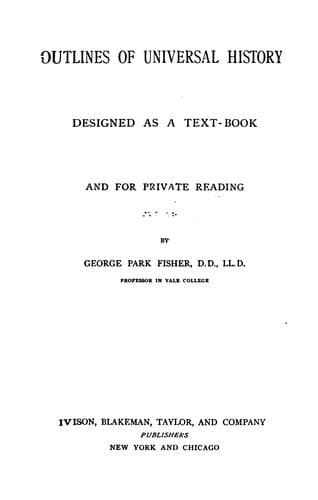
Outlines of Universal History, Designed as a Text-book and for Private ReadingFisher, George Park
History
Outlines of Universal History, Designed as a Text-book and for Private Reading
Fisher, George Park
World history
religious motives were active, but they were mingled on both sides
with political considerations. The alienation of feeling on the part
of the Roman bishops was one cause of the separation of Italy from the
Greek Empire.
LITERATURE AND CULTURE.--While there was a prevalence of illiteracy in
the West, there continued in the Eastern Empire an interest in
letters, and a respect for classical literature. Devoted Greek monks
taught the Gospel to the _Bulgarians_ and to the Slavonian tribes
on its borders. _Cyril_ and _Methodius_, faithful
missionaries, gave the Bible to the _Moravians_ in their own
tongue. In the seventh century, _John of Damascus_ compiled from
the Greek Fathers a celebrated treatise on theology. But the period of
original thought in theology, as elsewhere, had passed by. This work
of the Damascene was made up chiefly of excerpts from the Fathers
before him. In earlier days the church in the East had been served by
erudite theologians of great talents and of great excellence, such as
_Basil the Great_ (328-379), _Gregory of Nyssa, Gregory of
Nazianzum_ (326-390); all of whom were liberal-minded men,
strenuous defenders of orthodox doctrine, and yet not unfriendly to
philosophical study. Of even wider fame was _John Chrysostom_
(347-407), a preacher of captivating eloquence and of an earnest
Christian spirit, whose censure of the vices of the Byzantine court
provoked the wrath of the Empress _Eudoxia_, and twice drove him
into banishment. In the declining days of the empire, literary effort
was mainly confined to compilations and comments. _Eusebius_, in
the fourth century, had written a _History of the Church_, and a
_Chronicle_, or General History; and, a century later (about
432), _Zosimus_ composed a _History_ in a spirit of
antipathy to Christianity and of sympathy with the old religion. To
_Procopius_ (who died about 565) we owe an interesting history of
the times of _Justinian_. After the seventh century, all traces
of life and spirit vanish from the pages of the Byzantine
historians. In mathematics and astronomy, in architecture and
mechanics, the Byzantine Greeks were the teachers of the Arabians and
of the new peoples of the West. The Byzantine style of architecture
was of a distinct type, and was widely diffused.
Public-domain text, read in full here on John Shaqi.
Reviews
Reviews
No reviews yet
Be the first to share your thoughts on this work.
Elsewhere in the archive
Join the Discussion
Join the discussion
Sign in to leave a comment or review.
Sign InorCreate an account