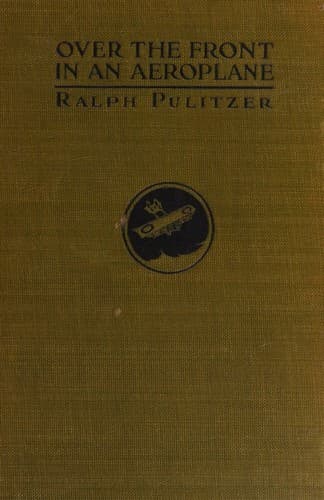
Over the Front in an Aeroplane, and Scenes Inside the French and Flemish TrenchesPulitzer, Ralph
History
Over the Front in an Aeroplane, and Scenes Inside the French and Flemish Trenches
Pulitzer, Ralph
World War, 1914-1918 -- Personal narratives
"To erect an independent Polish kingdom or state; to reconstitute
Belgium with indemnity; to hold a plebiscite in Alsace-Lorraine, taken
by a neutral, preferably the United States, in order to determine to
whom they should belong, and in what proportions; to dismember Turkey,
excepting Anatolia, which, being strictly Turkish, should be left to
the Turks; to enforce a very large degree of disarmament upon Germany
and Europe; to leave the German-speaking German Empire intact. (This
talk about the deposition of the Hohenzollerns as one of the peace
terms is sheer impertinence.)
"Now, you must readily perceive that any peace made in the near future
must conform or approximate to the German plans which I have outlined
and must involve a continuance of militarism and a standing incitement
to fresh wars. While a peace on the terms which we favor, a peace
that will perpetuate peace, must be wrung from a decisively beaten
Germany, and is therefore a long way off. That is why we shall have to
go through a very bad time of it for some period to come, and why our
ultimate victory will be at least one year, and possibly two or three
years off."
The keenest realization that victory will be slow, the completest
confidence that its certainty is axiomatic, is to be found in the
allied armies. There, ungrudgingly, they give the Germans fullest
credit for their preparedness, for their foresight, for their powers of
systematic and sustained labor, for their inventiveness. And they do
not waste their time trying to devise discrediting substitutes for such
words as "ability" in talking of their Generals, "courageousness" in
talking of their soldiers, and "patriotism" in talking of their people.
It is only when you get far behind the firing line that manliness
merges into meanness in estimating the enemy.
Yet these very officers who paid such soldierly tributes to their
antagonists were so wholly assured of eventual victory that any
scepticism on my part did not irritate them, but merely moved them to
good-natured smiles.
"So far," an English staff-officer remarked to me, "we English have
been bungling amateurs in the art of war contending against trained
professional specialists. But with a couple of years' more experience
I believe we shall know as much about it as they do, and then we shall
win."
"In the last analysis, talking from the military standpoint, this war,
like every war, will be won by men," said a French staff-officer.
"The Germans will not be beaten through lack of guns or ammunition or
machinery or supplies, but through lack of men. How long by the aid of
mechanics they can postpone the hour when the lack of men becomes fatal
to them I do not know--one year, two years. But in the end, with the
allied man-power steadily growing, and the German man-power steadily
lessening, their military collapse is inevitable."
These are typical of a score of similar views advanced by officers,
from Generals down to subalterns.
Public-domain text, read in full here on John Shaqi.
Reviews
Reviews
No reviews yet
Be the first to share your thoughts on this work.
Elsewhere in the archive
Join the Discussion
Join the discussion
Sign in to leave a comment or review.
Sign InorCreate an account