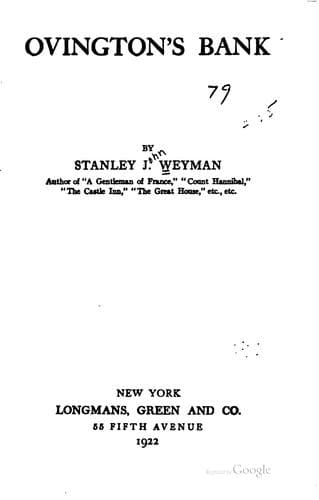
Banks and banking -- Fiction; England -- Social life and customs -- 19th century -- Fiction; Love stories
The doctor shut out the frightened maids and shut out Miss Peacock. But
Arthur was only at the beginning of his resources. His nerve was good
and he aided Farmer in his examination, while Jos, standing out of
sight behind the curtain, calm but quivering in every nerve, handed to
him or to Calamy what they needed. Even then, however, and while he was
thus employed, Arthur found occasion to whisper a cheering word to the
girl, to reassure her and give her hope. He forced her to take a glass
of wine, and when Calamy, shaking his head, muttered that he had known
a man to recover who had been worse hurt—but he was a strong young
fellow—he damned the butler for an old fool, regardless of the fact
that coming from Calamy this was a cheerful prognostic.
Presently he made her go downstairs. “Nothing more can be done now,”
said he. “The doctor thinks well of him so far. He and I will stay with
him to-night. You must save yourself, Jos. You will be needed
to-morrow.”
He left the room with her, and as she would not go to bed he made her
lie down on a couch, and covered her with a cloak. He had dropped the
tone of patronage, almost of persiflage, which he had used to her of
late, and he was kindness itself, behaving to her as a brother; so that
she did not know how to be thankful enough for his presence, or for the
relief from responsibility which it afforded. Afterwards, looking back
on that long, strange night, during which lights burned in the rooms
till dawn, and odd meals were served at odd times, and stealthy feet
trod the stairs, and scared faces peeped in only to be
withdrawn—looking back on that strange night, and its happenings, it
seemed to her that without him she could not have lived through the
hours.
In truth there was not much sleep for anyone. The village doctor, who
lived in top-boots, and went his rounds on horse-back, and by
old-fashioned people was called the apothecary, could say nothing for
certain; in the morning he might be able to do so. But in the
morning—well, perhaps by night, when the patient came to himself, he
might be able to form an opinion. To Arthur he was more candid. The eye
was beyond hope—it could not be saved, and he feared that the other eye
was injured; and there was serious concussion. He played with his fob
seals and looked sagely over his gold-rimmed spectacles as he mouthed
his phrases. Whether there was a fracture he could not say at present.
He had seen in a long life and a country practice many such cases, and
was skilful in treating them. But—no active measures. “Dr. Quiet,” he
said, “Dr. Quiet, the best of the faculty, my dear. If he does not
always effect a cure, he makes no mistakes. We must leave it to him.”
Public-domain text, read in full here on John Shaqi.
Reviews
Reviews
No reviews yet
Be the first to share your thoughts on this work.
Elsewhere in the archive
Join the Discussion
Join the discussion
Sign in to leave a comment or review.
Sign InorCreate an account