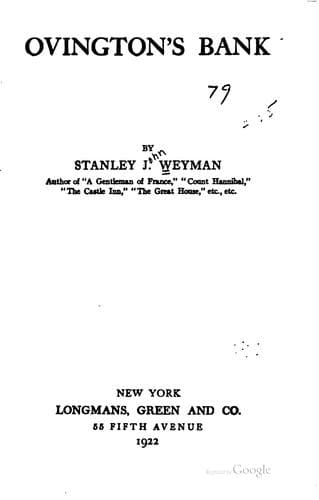
Banks and banking -- Fiction; England -- Social life and customs -- 19th century -- Fiction; Love stories
And Clement saw it all and rejoiced in it all, though his eyes never
ceased to search for a dour-looking man with a bruised face. He
rejoiced in the cantering horses and the abounding life about him, in
the freedom of it and the joyousness of it, his pulses leaping in tune
with it; and not the less in tune, so splendid a thing is it to be
young and in love, because he had fought a fight and slept only three
hours. He watched it all pass before him, and if he had ever believed
in his father’s scheme of an iron way and iron horses he lost faith in
it now. For it was impossible to believe that any iron road running
across fields and waste places could vie with this splendid highway,
this orderly procession of coaches, travelling and stopping and meeting
with the regularity of a weaver’s shuttle, these long lines of laden
wagons, these swift chaises horsed at every stage! He saw stables that
sheltered a hundred roadsters and were not full; ostlers to whom a
handful of oats in every peck gave a gentleman’s income; teams that
were clothed and curried as tenderly as children; mighty caravanserais
full to the attics. A whole machinery of transport passed under his
wondering eyes, and the railway, the Valleys Railway—he smiled at it as
at the dream of a visionary.
They swept through Northwich before noon, and an hour later Clement
dropped off the coach in front of the Bowling Green Inn at Altringham,
and knew that his task lay before him. The little town had no church,
but it boasted for its size more bustle than he had expected, and as he
eyed its busy streets and its flow of traffic his spirits sank; it did
not call itself one of the gates of Manchester for nothing. However, he
had not come to stand idle, and the first step, to seek out a
constable, was easy. But to secure that worthy’s aid—he was but a
deputy, a pot-bellied, spectacled shoemaker—was another matter. The man
rolled up his leather apron and pushed his horn-rimmed glasses on to
his forehead, but he shook his head. “A very desperate villain,” he
said, “a very desperate villain! But lor’, master, a dark sullen chap
with a black eye and legs a little bandy? Why, I be dark and I be
bandy, and for black eyes—I’m afeared there’s more than one o’ that cut
on the road.”
“But not to-day,” Clement urged. “He’ll come through to-day or
to-night.”
“Ay, and more likely night than day. But how be I to see if he’s a
blackened peeper in the dark! I can’t haul a gentleman off a coach to
ask the color of his eyes.”
“Well, anyway, do your best.”
“We might bill him and cry him?”
“That’s it! Do that!” Clement saw that that was about the extent of the
help he would get in this quarter. “Send the crier to me at the Bowling
Green, and I’ll write a bill—Five pounds reward for information!”
The constable’s eyes twinkled. “Now you’re on a line, master,” he said.
“Now we’ll do summat, maybe!”
Public-domain text, read in full here on John Shaqi.
Reviews
Reviews
No reviews yet
Be the first to share your thoughts on this work.
Elsewhere in the archive
Join the Discussion
Join the discussion
Sign in to leave a comment or review.
Sign InorCreate an account