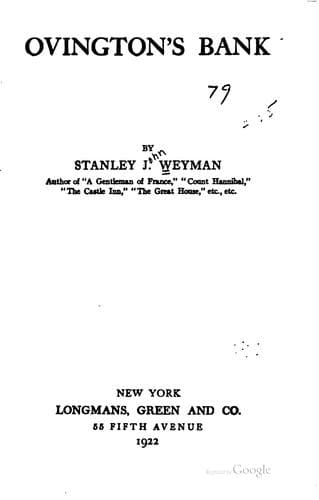
Banks and banking -- Fiction; England -- Social life and customs -- 19th century -- Fiction; Love stories
Not that Arthur was without his troubles. Naturally and inevitably a
cloud had fallen on the relation, friendly hitherto, between him and
Clement. Clement had grown cool to him, and the change was unwelcome,
for it was in Arthur’s nature to love popularity and to thrive and to
bask in the sunshine of it. But it could not be helped. Without
breaking eggs one could not make omelettes. Clement blamed him, he
knew, feeling, and with reason, that what he had done deserved
acknowledgment, and that it lay with Arthur to see that justice was
done. And Arthur, for his part, would have gladly acquitted himself of
the debt had it consisted with his own interests. But it did not.
Had he suspected the tie between Clement and Josina he might have acted
otherwise. He might have foreseen the possibility of Clement’s gaining
the old man’s ear, might have scented danger, and played a more
cautious game. But he knew nothing of this. Garth and Clement stood
apart in his mind. Clement and Josina were as far as he knew barely
acquainted. He was aware, therefore, of no special reason why Clement
should desire to stand well at Garth, while he felt sure that his
friend was the last person to push a claim, or to thrust himself
uninvited on the Squire’s gratitude.
Accordingly, and the more as the banker had not himself taken up the
quarrel, he put it aside as of no great importance. He shrugged his
shoulders and told himself that Clement would come round. The cloud
would pass, and its cause be forgotten.
In the meantime he ignored it. He met Clement’s hostility with bland
unconsciousness, smiled and was pleasant. He was too busy a man to be
troubled by trifles. He was not going to be turned from his course by
the passing frown of a silly fellow, who could not hold an advantage
when he had won it.
Betty was another matter. Betty was behaving ill and showing temper, in
league apparently with her brother and sympathizing with him. She was
changed from the Betty of old days. He had lost his hold upon her, and
though this fell in well enough with the change in his views—or the
possible change, for he had not quite made up his mind—it pricked his
conceit as much as it surprised him. Moreover, the girl had a sharp
tongue and was not above using it, so that more than once he smarted
under its lash.
“Fine feathers make fine birds!” she said, as Arthur came bounding into
the house one day and all but collided with her. “Only they should be
your own, Mr. Daw!”
“Oh, I give your father all the credit,” he replied, “only I do some of
the work. But you used not to be so critical, Betty.”
“No? Well, I’ll tell you why if you like.”
“Oh, I don’t want to know.”
“No, I don’t think you do!” the girl retorted. “But I’ll tell you. I
thought your feathers were your own then. Now—I should be uneasy if I
were you.”
“Why?”
“You might fall among crows and be plucked. I can tell you, you’d be a
sorry sight in your own feathers!”
Public-domain text, read in full here on John Shaqi.
Reviews
Reviews
No reviews yet
Be the first to share your thoughts on this work.
Elsewhere in the archive
Join the Discussion
Join the discussion
Sign in to leave a comment or review.
Sign InorCreate an account