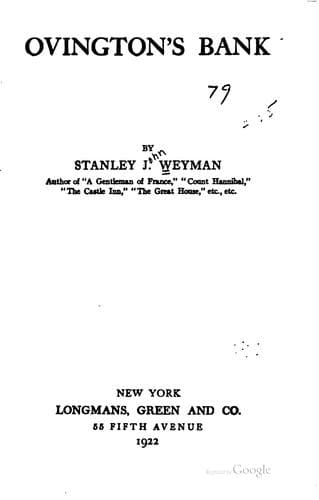
Banks and banking -- Fiction; England -- Social life and customs -- 19th century -- Fiction; Love stories
It masked a cupboard, contrived in the thickness of the chimney-breast,
perhaps at the time when the open shaft had been closed and a smaller
fireplace had been inserted. Inside, two shelves formed three
receptacles. In the uppermost were parcels of old letters secured with
dusty and faded ribands, and piled at random one on another—the relics
of the love-letters or law-letters of past generations. In the lowest
compartment were bigger bundles secured with straps, which Arthur
judged to contain leases and farm agreements, and the like. Some were
of late date—he took up one or two bundles and looked at the
endorsements—none of them appeared to be very old.
The middle space displayed a row of old ledgers and farm books, and
standing alone before them a small iron box. It was with this no doubt
that his business lay and he tried his key in it. The key fitted. He
opened the box.
It contained three certificates and, though he had been bidden not to
rout among them, he felt it his duty to ascertain—for he would probably
have to inform the brokers—what was the total of the Squire’s holding.
They all three represented India Stock, and Arthur’s eyes glistened as
he noted the amount and figured up the value in his mind. One, as the
Squire had said, was for two thousand two hundred, the other two were
for two thousand five hundred each. Arthur calculated that at the price
of the day they were worth little short of twenty thousand pounds. He
withdrew the smallest certificate and locked the box. He had done his
errand, but as he went about to close the cupboard-door he paused. He
had seen old letters, and modern agreements and the like. But no old
deeds. Where did the Squire keep the title deeds of Garth? They were
not here.
At Welshes? Perhaps.
Arthur glanced at the other side of the fireplace. There, precisely
corresponding with the almanac which he had removed, hung an
old-fashioned silver sconce with a flat back serving for a reflector. A
pair of snuffers flanked the candle-holder on one side, an extinguisher
on the other. It was a piece which Arthur had admired for its age but
had never seen in use. He stared at it, and as he closed the cupboard
and panel by which he stood, and replaced the bit of moulding, he
hesitated. With the keys in his hand he cast a glance at the windows,
then he crossed the hearth, took down the sconce, and ran his fingers
down the moulding.
Yes, here were the cracks, barely to be discovered by the fingers and
not at all by the eye. The bit of moulding, when he twisted it, moved
stiffly, but it moved. With another glance over his shoulder he
inserted the key, then he listened. All was quiet in the house.
Outside, a wood-pigeon coo’d in a neighboring tree while a solitary
rook uttered a shrill “Bah-doo! Bah-doo!” not the common caw, but a cry
that he had often heard.
Public-domain text, read in full here on John Shaqi.
Reviews
Reviews
No reviews yet
Be the first to share your thoughts on this work.
Elsewhere in the archive
Join the Discussion
Join the discussion
Sign in to leave a comment or review.
Sign InorCreate an account