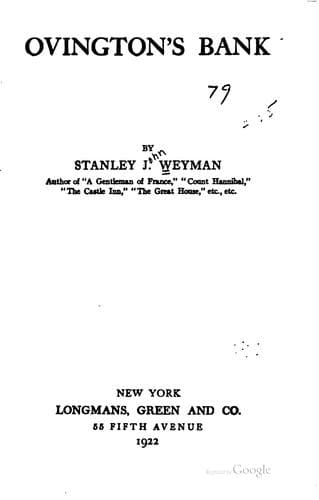
Banks and banking -- Fiction; England -- Social life and customs -- 19th century -- Fiction; Love stories
“He has added to it. One could raise fifty thousand on it,” he thought.
And with fifty thousand what could one not do? With fifty thousand
pounds, free money, added to the bank’s resources, what might not be
done? It was a golden vision that he saw, as he stood in the evening
stillness with the scent of roses stealing into the room, and the
wood-pigeon cooing softly in the tree outside. Ay, what might he not
do!
But the Squire might be growing suspicious. He roused himself, saw that
all was as he had found it, and unlocking the door, he went upstairs.
“You’ve been a long time about it, young man,” the Squire grumbled.
“What’s amiss?”
But Arthur was ready with his answer. “You told me to go about it
quietly, sir. So I waited until the coast was clear. It’s a capital
hiding-place. It’s not to be found in a minute even when you know where
it is.”
“Ay, ay. It would take a clever rogue to find it,” complacently.
“I suppose it’s old, sir?”
“My grandfather put it in when the Scots were at Derby. And, mark ye,
no one knows of it but Frederick Welsh—and now you. D’you be careful
and keep your mouth shut, lad. You ha’ got the certificate?”
“Yes, sir.”
“Well, go about the business and get it done. And now do you send Jos
to me.”
Arthur made a mental note that the old man was changing at last—was
losing that hard grip on all about him which he had maintained for half
a century; and he was confirmed in this idea by the ease with which the
India Stock transaction presently went through. The brokers showed
themselves unusually complaisant. They wrote that, as the matter was
personal to him, they were anxious that nothing should go wrong; and,
as his customer was blind, they were forwarding with the transfer on
which the particulars had been inserted a duplicate in blank, in order
that if the former were spoiled in the execution delay might be
avoided. This was irregular, but if the duplicate were not needed, it
could be returned and no harm done.
Arthur thought this polite of them, and was flattered; he felt that he
was a client of value. But as it turned out the duplicate was not
needed; the Squire made nothing of the formality. His hand once
directed to the proper place, he signed his name boldly and plainly—as
he did most things; and Arthur and Jos added their signatures as
witnesses. Ten days later the money was received, and five-sixths of it
was paid over to the bank. The duplicate transfer, overlooked at the
moment, lay on the Squire’s bureau until it did not seem worth while to
return it. Then Arthur, tired of coming upon it every day, thrust it
out of sight in a pigeonhole.
Public-domain text, read in full here on John Shaqi.
Reviews
Reviews
No reviews yet
Be the first to share your thoughts on this work.
Elsewhere in the archive
Join the Discussion
Join the discussion
Sign in to leave a comment or review.
Sign InorCreate an account