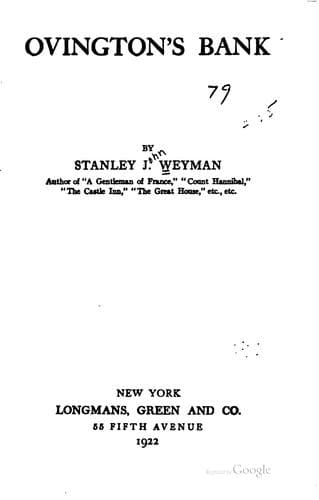
Banks and banking -- Fiction; England -- Social life and customs -- 19th century -- Fiction; Love stories
“Then, by G—d, it’s not I will be the only one to be ruined!” the man
exclaimed, and he struck the table with his fist. The veins on his
forehead swelled, his coarse mottled face became disfigured with rage.
He glared at the banker. But even as Ovington met his gaze, there came
a change. The perspiration sprang out on his forehead, his face turned
pale and flabby, he seemed to shrink and wilt. The ruin, which
recklessness and improvidence had hidden from him, rose before him,
certain and imminent. He saw his mill, his house, his all gone from
him, saw himself a drunken, ruined, shiftless loafer, cadging about
public-houses! “For God’s sake!” he pleaded, “do it this once, Mr.
Ovington. Meet just these two, and I’ll swear they’ll be the last. Meet
these.”
“No,” the banker said. “We go no farther.”
Perhaps the thought that he and Ovington had risen from the ranks
together, that for years they had been equals, and that now the one
refused his help to the other, rose and mocked the unhappy man. At any
rate, his rage flared up anew. He swore violently. “Well, there’s more
than I will go down, then!” he said. “And more than will suit your
book, banker! Wise as you think yourself, there’s more bills out than
you know of!”
“I am sorry to hear it.”
“Ay, and you’ll be more sorry by and by!” viciously. “Sorry for
yourself and sorry that you did not give me a little more help, d—n
you! Are you going to? Best think twice about it before you say no!”
“Not a penny,” Ovington rejoined sternly. “After what you have admitted
I should be foolish indeed to do so. You’ve had my last word, Mr.
Wolley.”
“Then damn your last word and you too!” the clothier retorted, and went
out, cursing, into the bank, shouting aloud as he passed through it,
that they were a set of bloodsuckers and that he’d have the law of
them! Clement from his desk eyed him steadily. Rodd and the clerks
looked startled. The customers—there were but two, but they were two
too many for such a scene—eyed each other uneasily. A moment, and
Clement, after shifting his papers uncertainly, left his desk and went
into the parlor.
Ovington and Arthur had not moved. “What’s the matter?” Clement asked.
The occurrence had roused him from his apathy. He looked from the one
to the other, a challenge in his eyes.
“Only what we’ve been expecting for some time,” his father answered.
“Wolley has asked for further credit and I’ve had to say, no. I’ve
given him too much rope as it is, and we shall lose by him. He’s an
ill-conditioned fellow, and he is taking it ill.”
“He wants a drubbing,” said Clement.
Public-domain text, read in full here on John Shaqi.
Reviews
Reviews
No reviews yet
Be the first to share your thoughts on this work.
Elsewhere in the archive
Join the Discussion
Join the discussion
Sign in to leave a comment or review.
Sign InorCreate an account