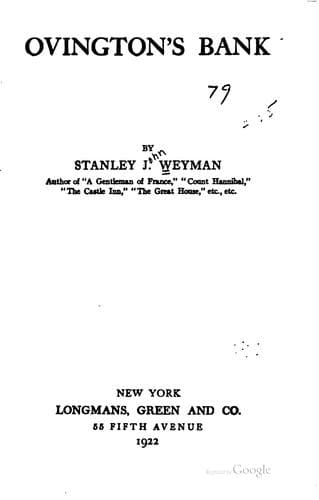
Banks and banking -- Fiction; England -- Social life and customs -- 19th century -- Fiction; Love stories
“Don’t love him?” the Squire repeated—yet not half so angrily as she
expected. “What’s amiss with him?’”
“Nothing, sir. But I do not love him.”
“Love? Bah! Love’ll come! Maids ha’ naught to do with love! When
they’re married love’ll come fast enough, I’ll warrant! The lad’s
straight and comely and a proper age—and what else do you want? What
else do you want, eh? He’s of your own blood, and if he’s wild ideas
’tis better than wild oats, and he’ll give them up. He’s promised me
that, or I’d never ha’ said yes to him! Why, girl!” with sudden
exasperation, “’twas only the other day you were peaking and puling for
him! Peaking and puling like a sick sparrow, and I was saying, no! And
now—why, damme, what do you mean by it?”
“It was all a mistake, sir,” she said with dignity. “I never did think
of him, or wish for him. It was a mistake.”
“A mistake! What do you mean?”
“You bade me think no more of him, and I obeyed. But—but I never had
any thought of him.”
That did irritate the old man; it seemed to him that she played with
him. In a rage he struck his cane on the ground. “Damme!” he exclaimed.
“That’s womanlike all over! Give her what she wants and she doesn’t
want it. But, see here, I’ll not have it, girl. I know your flimsies
and you’ve got to have him! Do you hear?”
He was enraged by this queer twist in her, and he blustered. But his
anger—and he felt it—lacked something of force. He did not know how to
bring it to bear. And when she did not reply to him at once, “Do you
forget that he saved my life?” he cried, dropping to a lower level.
“D’you forget that, you ungrateful wench?”
“But he did not save mine, sir!” she answered, with astonishing spirit.
“Yet it is mine that you ask me to give him. And indeed, indeed, sir,
he does not love me.”
“Then why should he want you?” he retorted. “But he’ll soon make you
sure of that, if you’ll let him. And you’ve got to take him. You’ve got
to take him. Let’s ha’ no more words about it. I’ve said the word.”
“But I’ve not, sir,” she replied, with that new and astonishing courage
of hers. “And I cannot say it. I am grateful to him, I shall ever be
grateful to him for saving you—and he is my cousin. But he does not
love me, he has never made love to me. And am I, your daughter, to—to
accept him, the moment it suits him to marry me?”
That touched the Squire’s pride. It gave him to think. “Never made love
to you?” he exclaimed. “What do you mean, girl?”
“Until he came to me in the garden on Tuesday he never—he never gave me
reason to think that he would come. Am I,” with a tremor of indignation
in her voice, “of so little account, is that which you have just told
me that I may some day bring to him so little, that I must put all in
his hand the moment he chooses to lift it?”
The Squire was bothered by that, and “You are like all women!” he
exclaimed. “I don’t know where to ha’ you. That’s where it is. You
twist and you turn, and you fib——”
“I am not fibbing, sir.”
Public-domain text, read in full here on John Shaqi.
Reviews
Reviews
No reviews yet
Be the first to share your thoughts on this work.
Elsewhere in the archive
Join the Discussion
Join the discussion
Sign in to leave a comment or review.
Sign InorCreate an account