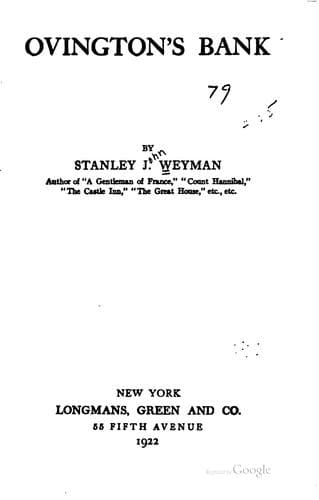
Banks and banking -- Fiction; England -- Social life and customs -- 19th century -- Fiction; Love stories
“Arthur? No, sir. Not till after Thomas was gone. And it was Clement
who followed Thomas to Birmingham and got the money back.” For Clement
had told her that also.
When she had done, the Squire leant forward and felt again for his
stick, as if he were now equipped and ready for action. “Well, you
begone,” he said, harshly. “You begone, now. I’ll see to this.”
But, “Not till you forgive me,” she entreated, holding him close, and
pressing her face against his unwilling breast. “And there’s more,
there’s more, sir,” in growing agitation, “I must tell you. Be good to
me, oh, be good to me! Forgive me and help him.”
“Help him!” the Squire cried, and this time he was indeed amazed. “I
help him! Help the man who has gone behind my back and stolen my girl!
Help the man who—let me go! Do you hear me, girl! Let me get up, you
shameless hussy!” growing moment by moment more himself, as he
recovered from the shock of her disclosure, and could measure its
extent. “How do I know what you are? Or what he mayn’t have done to
you? Help, indeed? Help the d—d rascal who has robbed me? Who has dared
to raise his eyes to my girl—a Griffin? Who——”
“He saved your life,” she cried, pleading desperately with him, though
he strove to free himself. “Oh, father, he saved your life! And I love
him! I love him! If you part us I shall die.”
He could not struggle against her young strength, and he gave up the
attempt to free himself. He sank back in his chair. “D—n the girl!” he
cried. He sat silent, breathing hard.
And she—she had told him, and she still lived! She had told him and he
had not cursed her, he had not struck her to the ground, he had not
even succeeded in putting her from him! She had told him, and the world
still moved about her, his gold watch, which lay on the table on a
level with her head, still ticked, the dog still barked in the field
below. Miss Peacock’s voice could still be heard, invoking Calamy’s
presence. She had told him, and he was still her father, nay, if she
was not deceived, he was more truly her father, nearer to her, more her
own, than he had ever been before.
Presently, “Ovington’s son! Ovington’s son!” he muttered in a tone of
wonder. “Good God! Couldn’t you find a man?”
“He is a man,” she pleaded, “indeed, indeed, he is!”
“Ay, and you are a woman!” bitterly. “Fire and tow! A few kisses and
you are aflame for him. For shame, girl, for shame! And how am I to be
sure it’s no worse? Ain’t you ashamed of yourself?”
She shivered, but she was silent.
“Deceiving your father when he was blind!”
She clung to him. He felt her trembling convulsively.
Public-domain text, read in full here on John Shaqi.
Reviews
Reviews
No reviews yet
Be the first to share your thoughts on this work.
Elsewhere in the archive
Join the Discussion
Join the discussion
Sign in to leave a comment or review.
Sign InorCreate an account