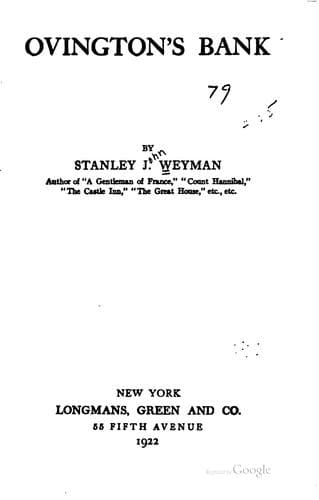
Banks and banking -- Fiction; England -- Social life and customs -- 19th century -- Fiction; Love stories
And with reason. For if he who has inherited success and lives to see
it threatened suffers a pang, that pang is as nothing besides the
humiliation of the man who has raised himself; who has outstripped his
fellows, challenged their admiration, defied their jealousy, trampled
on their pride; who has been the creator of his own greatness, and now
sees that greatness in ruins. He had escaped that. He had escaped that,
thank God! More than once the two words passed his lips; and in secret
his thoughts turned to the great chief of men to whom in his own mind
and with a rather absurd vanity he had compared himself. Thank God that
his own little star had not sunk like his into darkness!
It was relief, it was salvation. And that evening, as the banker sat
after his five o’clock dinner and sipped his fourth and last glass of
port and basked in the genial heat of the fire, while his daughter
knitted on the farther side of the hearth, he owned himself a happy
man. He measured the danger, he winced at the narrow margin by which he
had escaped it—but he had escaped! Dean’s, staid, long-established,
slow-going Dean’s, which had viewed his notes askance, had doubted his
stability and predicted his failure, Dean’s which had slyly put many a
spoke in his wheel, would not triumph. Nay, after this, would not he,
too, rank as sound and staid and well established, he who had also
ridden out the storm? For in crises men and banks age rapidly; they are
measured rather by events than by years. Those who had mistrusted him
would mistrust him no longer; those who had dubbed him new would now
count him old. As he stretched his legs to meet the genial heat and
sank lower in his chair he could have purred in his thankfulness.
Things had fallen out well, after all; he saw rosy visions in the fire.
Schemes which had lain dormant in his mind awoke. His London agents had
failed, but others would compete for his business, and on better terms.
The Squire who had so marvellously come to his aid would bring back his
account, and his example would be followed. He would extend, opening
branches at Bretton and Monk’s Castle and Blankminster, and the
railroad? He was not quite sure what he would do about the railroad;
possibly he might decide that the time was not ripe for it, and in that
case he might wind up the company, return the money, and himself meet
the expenses incurred. The loss would not be great, and the effect
would be prodigious. It would be a Napoleonic stroke—he would consider
it. He lost himself in visions of prosperity.
And it would be all for Clement and Betty. He looked across the hearth
at the girl who sat knitting under the lamp-light, and his eyes
caressed her, his heart loved her. She would make a great match.
Failing Arthur—and of late Arthur and she had not seemed to hit it
off—there would be others. There would be others, well-born, who would
be glad to take her and her dowry. He saw her driving into town in her
carriage, with a crest on the panels.
Public-domain text, read in full here on John Shaqi.
Reviews
Reviews
No reviews yet
Be the first to share your thoughts on this work.
Elsewhere in the archive
Join the Discussion
Join the discussion
Sign in to leave a comment or review.
Sign InorCreate an account