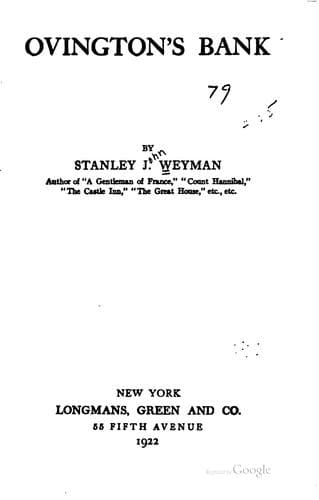
Banks and banking -- Fiction; England -- Social life and customs -- 19th century -- Fiction; Love stories
“No, no, that’s impossible!” Ovington straightened himself with a sigh
of relief. What mare’s nest, what bee in the bonnet, was this? The lad
was dreaming—must be dreaming. “Impossible!” he repeated. “I saw it,
man, and read it! And I know the old man’s signature as well as I know
my own. You must be dreaming.”
“I am not, sir!” Clement answered, and added bitterly, “It was Arthur
who was dreaming! Dreaming or worse, d—n him!”—the pent-up excitement
of the evening finding vent at last, and the sight of his father’s
stricken face whetting his rage. “He has robbed, ay, robbed his uncle,
and dishonored us! That is what he has done, sir. I am not dreaming! I
wish to heaven I were!”
The banker no longer protested. “Well—tell us!” he said weakly.
“It’s hard on you, sir——”
“Never mind me! Tell me what you know.” They stood round Clement,
amazed and shocked, fearing the worst and yet incredulous, while he,
his weary face and travel-stained figure at odds with the lighted room
and the comfort about him, told his story. The banker listened. He
still hoped, hoped to detect some flaw, to perceive some
misunderstanding—so much, so very much, hung upon it. But even on his
mind the truth at last forced itself, and monstrous as the story,
incredible as Arthur’s action still appeared, he had at last to accept
it and its consequences—its consequences!
He seemed to grow years older as he listened, but when Clement had
done, and the whole shameful story was told, he made no comment. The
position, indeed, was no worse than it had been twenty-four hours
before. He might still hope against hope, that, by putting a bold face
on matters, and by a dexterous use of his resources, he might ride out
the storm. But the reaction from a triumphant confidence was so sudden,
the failure of his recent expectations so overwhelming, that even his
firm spirit yielded. He sank into his chair. Betty laid her hand on his
shoulder and whispered some word of comfort in his ear, but he said
nothing.
It was Clement who spoke the first word. “I am going after him,” he
said, his tone hard and practical. “I have thought it out, and by
posting all night I may be in London by noon to-morrow, and I may
intercept him either at the brokers’ or at the India House before he
has sold the stock. In that case I may be in time to stop him.”
“Why?” the banker asked, looking up. “What have we to do with him? Why
should we stop him?”
Public-domain text, read in full here on John Shaqi.
Reviews
Reviews
No reviews yet
Be the first to share your thoughts on this work.
Elsewhere in the archive
Join the Discussion
Join the discussion
Sign in to leave a comment or review.
Sign InorCreate an account