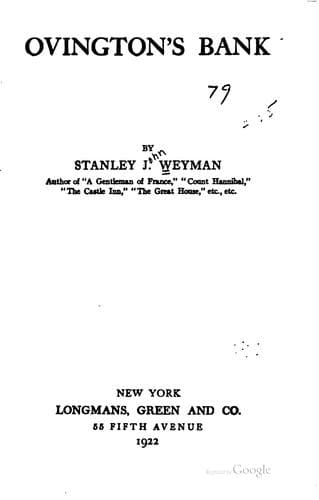
Banks and banking -- Fiction; England -- Social life and customs -- 19th century -- Fiction; Love stories
inflamed with greed and fear, upon his slender defences?
He was buying honesty at a great price. But he thought of Clement and
Betty, and towards morning he fell asleep.
CHAPTER XXXIII
Travelling in the old coaching days was not all hardship. It had its
own, its peculiar pleasures. A writer of that time dwells with
eloquence on the rapture with which he viewed a fine sunrise from the
outside of a fast coach on the Great North Road; on the appetite with
which he fell to upon a five o’clock breakfast at Doncaster, on the
delight with which he heard the nightingales sing on a fine night as he
swept through Henley, on the satisfaction of seeing old Shoreditch
Church, which betokened the end of the journey. Men did not then hurry
at headlong speed along iron rails, with their heads buried in a
newspaper or in the latest novel. They learned to know and had time to
view the objects of interest that fringed the highway—to recognize the
farm at which the Great Durham Ox was bred, and the house in which the
equally great Sir Isaac Newton was born. If these things were strange
to the travellers and their appearance promised a good fee, the
coachman condescended from his greatness and affably pointed them out.
But to sit through the long winter night, changing each hour from one
damp and musty post-chaise to another, to stamp and fume and fret while
horses were put to at every stage, to scold an endless succession of
incoming and fee an endless series of out-going postboys, each more
sleepy and sullen than the last—this was another matter. To be delayed
here and checked there and overcharged everywhere, to be fobbed off
with the worst teams—always reserved for night travellers—and to find,
once started on the long fourteen-mile stage, that the off-wheeler was
dead lame, to fall asleep and to be aroused with every hour—these were
the miseries, and costly miseries they were, of old-world journeying.
This was its seamy side. And many a time Clement, stamping his
stone-cold feet in wind-swept inn yards, or ringing ostlers’ bells in
stone-paved passages, repented that he had started, repented that he
had ever undertaken the task.
Why had he, he asked himself more than once that bitter night. What was
Arthur Bourdillon to him that he should spend himself in an effort as
toilsome as it promised to be vain, to hold him back from the
completion of his roguery? Would Arthur ever thank him? Far from it.
And Josina? Josina, brave, loving Josina, who had risen to heights of
which he thrilled to think, she might indeed thank him—and that should
be enough for him. But what could she do to requite him, apart from her
father? And the Squire at Garth had stated his position, nor even if he
relented was he one to pour himself out in gratitude—he who hated the
name of Ovington, and laid all this at their door. It would be much if
he ever noticed him with more than a grunt, or ever gave one thought to
his exertions or their motive.
Public-domain text, read in full here on John Shaqi.
Reviews
Reviews
No reviews yet
Be the first to share your thoughts on this work.
Elsewhere in the archive
Join the Discussion
Join the discussion
Sign in to leave a comment or review.
Sign InorCreate an account