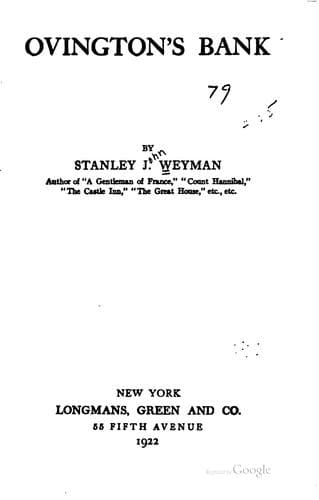
Banks and banking -- Fiction; England -- Social life and customs -- 19th century -- Fiction; Love stories
One or two were tempted to ask why he hadn’t drawn out his seventy-five
pounds, if he had been so sure. But they refrained, having a wambling,
a sort of sick feeling in the pit of their stomachs. He was a rude,
overbearing fellow, and there was no knowing what he might not bring
out by way of retort.
The upshot of this and of a hundred other reports which ran about the
town like wild-fire, was that a full twenty minutes before the bank
opened on the Tuesday, its doors were the butt of a hundred eyes. Many
assembled by twos and threes in the High Street and on the Market
Place, awaiting the hour; while others took up their stand in the dingy
old Butter Cross a little above the bank, where day in and day out old
crones sat knitting and the poultry women’s baskets stood on market
days. Few thought any longer of concealment; the time for that was
past, the feeling of anxiety was too deep and too widespread. Men came
together openly, spoke of their fears and cursed the banker, or
nervously fingered their pass-books, and compared the packets of notes
that they had with them.
Some watched the historic clock, but more watched, and more eagerly,
the bank. The door, the opening of which, if it were ever opened, meant
so much to so many, must have shrunk, seasoned wood as it was, under
the intensity of the gaze fixed upon it; while the windows of the
bank-house—ugh! the pretender, to set himself up after that fashion,
while all the time he was robbing the poor!—were exposed to a fire as
constant. Not a curtain moved or a blind was lowered, but the action
was marked and analyzed, deductions drawn from it, and arguments based
upon it. That was Ovington’s bedroom! No, that. And there was his girl
at the lower window—but he would not have been likely to take her with
him in any case.
As a fact, had they been on the watch a little earlier, they would have
been spared one anxiety. For about nine o’clock Ovington had shown
himself. He had left the house, crossed with a grave face to the Market
Place, and rung the bell at Dean’s. He had entered after a brief parley
with an amazed man-servant, had been admitted to see one of the
partners, and at a cost to his pride, which only he could measure, the
banker had stooped to ask for help. Between concerns doing business in
the same town, relations must exist and transactions must pass even
when they are in competition; and Dean’s and Ovington’s had been no
exception to the rule. But the elder bank had never forgotten that they
had once enjoyed a monopoly. They had neither abandoned their claims
nor made any secret of their hostility, and Ovington knew that it was
to the last degree unlikely that they would support him, even if they
had the power to do so.
Public-domain text, read in full here on John Shaqi.
Reviews
Reviews
No reviews yet
Be the first to share your thoughts on this work.
Elsewhere in the archive
Join the Discussion
Join the discussion
Sign in to leave a comment or review.
Sign InorCreate an account