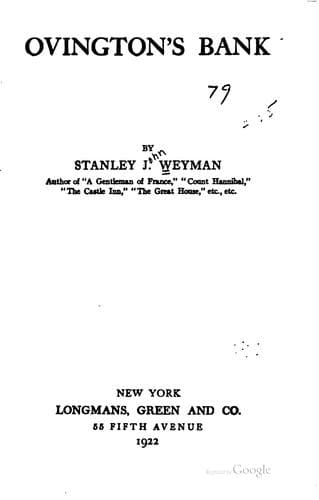
Banks and banking -- Fiction; England -- Social life and customs -- 19th century -- Fiction; Love stories
But the other shook his head. He was enjoying his triumph—a triumph
beyond his hopes. “What you suggest,” he said, a faint note of sarcasm
in his tone, “comes to this, Mr. Ovington—that we pool resources? That
is how I understand you?”
“Practically.”
“Well, I am afraid that in justice to our customers I must reply that
we cannot do that. We must think of them first, and of ourselves next.”
Ovington took up his hat. The other’s tone was coldly decisive. Still
he made a last effort. “Here is the list,” he said. “Perhaps if you and
your brother went over it at your leisure?”
But Dean waved the list away. “It would be useless,” he said. “Quite
useless. We could not entertain the idea.” He was already anticipating
the enjoyment with which he would tell his brother the news.
With a heavy heart, Ovington replaced the list in his breast pocket.
“Very good,” he said. His face was grave. “I did not expect—to be
frank—any other answer, Mr. Dean. But I thought it was my duty to see
you. I regret your decision. Good-morning.”
“Good-morning,” the other banker replied, and he rang for his
man-servant.
“They’re gone,” he reflected complacently, as the door closed behind
his visitor. “Smashed, begad!” and with the thought he rid himself of a
sense of inferiority which had more than once troubled him in his
rival’s presence. He sat down to eat his breakfast with a good
appetite. The day would be a trying one, but Dean’s, at any rate, was
safe. Dean’s, thank God, had never put its hand out farther than it
could draw it back. How pleased his brother would be!
That was the worst, immeasurably the worst, of Ovington’s experiences,
but it was not the only painful interview that was in store for him
before the bank opened that morning. Twice, men, applying, stealthy and
importunate, at the back door, forced their way in to him. They were
not of those who had claims on the bank and feared to be losers by it.
They were in debt to it, but desperate and pushed for money they saw in
the bank’s necessity their opportunity. They—one of the two was
Purslow—required only small sums, and both had conceived the idea that,
as the bank was about to fail, it would be all one to Ovington whether
he obliged them or not. It would be but a hundred or so the less for
the creditors, and as the bank had sold their pledged stocks they
thought that it owed them something. They had still influence, their
desperate straits were not yet known; if he obliged them they would do
this and that and the other—nebulous things—for him.
Ovington, of course, could do nothing for them, but to harden his heart
against their appeals was not a good preparation for the work before
him, and when he entered the bank five minutes before ten, he had to
brace himself in order to show an unmoved front to the clerks.
Public-domain text, read in full here on John Shaqi.
Reviews
Reviews
No reviews yet
Be the first to share your thoughts on this work.
Elsewhere in the archive
Join the Discussion
Join the discussion
Sign in to leave a comment or review.
Sign InorCreate an account