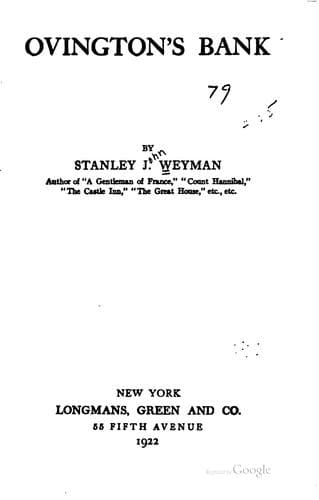
Banks and banking -- Fiction; England -- Social life and customs -- 19th century -- Fiction; Love stories
She had seen to it that the fire was clear and the lamps burned
brightly; had she not visited the room a dozen times to see to it? And
now the curtains had been drawn, the tea-tray had come in, the kettle
sang on the hob, the silver and china, reflecting the lights, twinkled
a pleasant welcome to the tired man. Or they would have, if he could
have believed that the comfort about him was permanent. But how
long—the doubt tortured him—would it be his? How long could he ensure
it for others? The waiting, anxious crowd, the scared faces, the
clamorous customers, these were the things he saw, the things that
blotted out the room and darkened the future. These were the only
realities, the abiding, the menacing facts of life. He let his chin
fall on his hand, and gazed moodily into the fire. A Napoleon of
finance? Ay, but a Napoleon, crushed in the making, whose Waterloo had
met him at Arcola!
He straightened himself when Rodd’s step was heard in the passage, and
he rose to take the last slip from the cashier’s hand.
“Sit down, man, sit down,” he said. “Betty, give Rodd a cup of tea. He
must need it. Well?” putting on his glasses to consult the slip.
“We’ve paid out thirteen thousand two hundred and ten, sir.”
“Through one pair of hands! Well done! A fine feat, Rodd, and I shall
not forget it. Umph!” thoughtfully, “that is just about what we
expected. Neither much better nor much worse. What we did not
expect—but sit down and drink your tea, man. Betty!”
“Yes, father.”
“Pass the toast to him. He deserves all we can do for him. What we did
not expect,” reverting to the slip with a wrinkled brow, “were the
payments in. Four hundred and seventy odd! I don’t understand that. No
other sign of returning credit, Rodd? Was it some one we’ve obliged?
Very unlikely, for long memories are rare at such times as these. Who
was it?”
Rodd was busy with his toast. Betty had passed it to him with a polite
smile. “There were two, sir, I think,” he said. He spoke as if he were
not quite certain.
The banker looked up in surprise. “Think!” he said. “Why, you must
know.”
“Well, there were two, sir, I am sure. But paying out all day——”
“You’d remember who paid in, I should think. When there were but two.
You must remember who they were.”
“One was from Wolverhampton, I know,” Rodd replied, “Mr. Watkins—or
Walker.”
“Walker or Watkins? Of Wolverhampton? I don’t remember any customer of
that name. And the other? Who was he?”
“From somewhere Bretton way. I could look him up.”
The banker eyed Rodd closely. Had the day’s work been too much for him?
“You could look him up?” he rejoined. “Why, man, of course you could.
Four hundred and seventy! A bank has failed before now for lack of
less. All good notes, I suppose? No Gibbons’ or Garrards’, eh?” an idea
striking him. “But you’d see to that. If some one had the idea of
washing his hands that way—and the two banks already closed!”
Public-domain text, read in full here on John Shaqi.
Reviews
Reviews
No reviews yet
Be the first to share your thoughts on this work.
Elsewhere in the archive
Join the Discussion
Join the discussion
Sign in to leave a comment or review.
Sign InorCreate an account