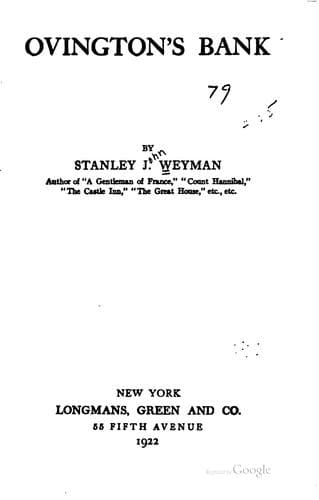
Banks and banking -- Fiction; England -- Social life and customs -- 19th century -- Fiction; Love stories
The Squire handled the packet, felt its thickness, weighed it lovingly
in his hand. So much money, so much money in so small a space! Six
thousand and odd pounds! It seemed as if he could not let it go, but in
the end he placed it in the breast pocket of his high-collared old
coat, the shabby blue coat with the large gilt buttons that was his
common wear at home. The money secured, he sat, looking before him,
while Clement, a little mortified, waited for the word of
acknowledgment that did not come. At last, “Did you call at your
father’s?” the old man asked—irrelevantly, it seemed.
Clement colored. He had not expected the question. “Well, I did, sir,”
he admitted. “Bourdillon——”
“He was with you?”
“As far as the town. He was anxious that the money should be seen to
arrive. He thought that it might check the run, and I agreed that it
might do some good, and that we might make that advantage of it. So I
took it through the bank.”
“Pretty full, I expect, eh? Pretty full?”
“Well,” ruefully, “it was, sir.”
“A strong run, eh?”
“I’m afraid so. It looked like it. It was full to the doors. That’s
why,” glancing at his watch as he stood by the window, the table
between him and the Squire, “I must get back to my father. We took it
through the bank and out by the garden, and put it in the chaise again
in Roushill.”
“Umph! He came back to town with you?”
“Bourdillon, sir? Yes—as far as the East Bridge. He left me there.”
“Where is he?”
Clement hesitated. “I hope that he’s gone to the bank, sir,” he said.
He did not add, as he might have, that, after Arthur and he had left
the coach at Birmingham and posted on, there had been a passionate
scene between them. No doubt Arthur had never given up hope, but from
the first had determined to make another fight for it; and there was no
police officer at their elbows now. He had appealed to Clement by all
that he loved to take the money to the bank, and there to deal with it
as his father should decide. Finding Clement firm and his appeals
useless, he had given way to passion, he had stormed and threatened and
even shed tears; and at last, seizing the pistol case that lay at their
feet, he had sworn that he would shoot himself before the other’s eyes
if he did not give way. In his rage he had seemed to be capable of
anything, and there had been a struggle for the pistol, blows had been
exchanged, and worse might have come of it if the noise of the fracas
had not reached the postboy’s ears. He had pulled up, turned in his
saddle, and asked what the devil they would be at; he would have no
murder in his master’s carriage.
Public-domain text, read in full here on John Shaqi.
Reviews
Reviews
No reviews yet
Be the first to share your thoughts on this work.
Elsewhere in the archive
Join the Discussion
Join the discussion
Sign in to leave a comment or review.
Sign InorCreate an account