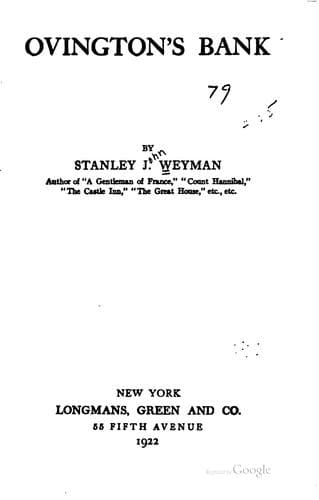
Banks and banking -- Fiction; England -- Social life and customs -- 19th century -- Fiction; Love stories
But as she put the pen in his hand he let it drop. He sat back in his
chair. “Ay, he showed me the place before,” he muttered, his chin on
his breast. “It was he gave me the pen, then, girl. And how be I to
know? How be I to know?”
It came home to them—to them both. In his voice, his act, his attitude
was the pathos of blindness, its helplessness, its dependence, its
reliance on others—on the eyes, the hand, the honesty of others. The
girl leant over him. “Father,” she said, tears in her voice, “I
wouldn’t deceive you! You know I wouldn’t. I would never deceive you!”
“Ha’ you never deceived me? Wi’ that young man?” sternly.
“But——”
“Ay, you have! You have deceived me—with him.”
She could not defend herself, and, suppressing her sobs, “I will call
Calamy,” she said. “He can read. He shall count the notes.”
But he put out his hand and grasped her skirts. “No,” he said. “What’ll
I be the better? Give me the pen. If you deceive me in this, wench—what
matter if the notes be short or not, or what comes of it?”
“I would cut off my hand first!” she cried. “And Clement——”
“Eh?” He sat up sharply.
She was frightened, and she did not continue. “This is the place, sir,”
she said meekly.
“Here?”
“Yes, sir, where you are now.”
He wrote his name. “Dry it,” he said. “And ring the bell. And there,
give it to him. He wants to be off. Odds are the shutters’ll be up
afore he gets there. Calamy!” to the man who had appeared at the door,
“see this gentleman off, and be quick about it. He’s no time to lose.
And, hark you, come back to me when he’s gone. No, girl,” sternly, “you
stay here. I want you.”
CHAPTER XXXIX
In ordinary times, news is slow to make its way to the ears of the
great. Protected from the vulgar by his deer park, looking out from the
stillness of his tall-windowed library on his plantations and his
ornamental water, Sir Charles Woosenham was removed by six miles of
fine champaign country from the common fret and fume of Aldersbury. He
no longer maintained, as his forefathers had maintained, a house in the
town, and in all likelihood he would not have heard the talk about the
bank, or caught the alarm in time, if one of his neighbors had not made
it his business to arouse him.
Acherley, baffled in his attempt at blackmail, and thirsting for
revenge, had bethought him of the Chairman of the Valleys Railroad. He
had been quick to see that he could use him, and perhaps he had even
fancied that it was his duty to use him. At any rate, one fine morning,
some days before this eventful Wednesday, he had mounted his old
hunter, Nimrod, and had cantered across country by gaps and gates from
Acherley to Woosenham Park. He had entered by a hunting wicket, and
leaping the ha-ha, he had presented himself to Sir Charles ten minutes
after the latter had left the breakfast table, and withdrawn himself
after his fashion of a morning, into a dignified seclusion.
Public-domain text, read in full here on John Shaqi.
Reviews
Reviews
No reviews yet
Be the first to share your thoughts on this work.
Elsewhere in the archive
Join the Discussion
Join the discussion
Sign in to leave a comment or review.
Sign InorCreate an account