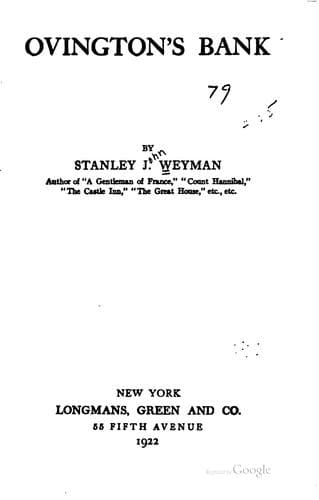
Banks and banking -- Fiction; England -- Social life and customs -- 19th century -- Fiction; Love stories
He left a flustered, nervous, unhappy man behind him. “Good G—d!” the
baronet muttered, as he rose and paced his library, all the peace and
pleasantness of his life shattered. “What’s to be done? And why—why in
the world did I ever put my hand to this matter!” One by one and
plainly all the difficulties of the position rose before him, the
awkwardness and the risk. He must open the thing to Bourdillon—in
itself a delicate matter—and obtain his signature. If he got that, he
doubted if he had even then power to draw the whole amount in this way,
and doubted, too, whether Ovington would surrender it, no meeting of
the Board having been held? And if he obtained the money, what was he
to do with it? Pay it into Dean’s? But if things were as bad as
Acherley said, was even Dean’s safe? For, of a certainty, if he removed
the money to Dean’s and it were lost, he would be responsible for every
penny—every penny of it! There was no doubt about that.
Yet if he left it at Ovington’s and it were lost, what then? It was not
his custom to drink of a morning, but his perturbation was so great
that he took a glass of the cherry-brandy. He really needed it.
He could not tell what to do. In every direction he saw some doubt or
some difficulty arise to harass him. He was no man of business. In all
matters connected with the Company he had leant on Ovington, and
deprived of his stay, he wavered, turning like a weathercock in the
wind, making no progress.
For two days, though terribly uneasy in his mind, he halted between two
opinions. He did nothing. Then tidings began to come to his ears, low
murmurs of the storm which was raging afar off; and he wrote to
Bourdillon asking him to come out and see him—he thought that he could
broach the matter more easily on his own ground. But two days elapsed,
during which he received no answer, and in the meantime the warnings
that reached him grew louder and more disquieting. His valet let drop a
discreet word while shaving him. A neighbor hoped that he had nothing
in Ovington’s—things were in a bad way, he heard. His butler asked
leave to go to town to cash a note. Gradually he was wrought up to such
a pitch of uneasiness that he could not sleep for thinking of the ten
thousand pounds, and the things that would be said of him, and the
figure that he would cut if, after Acherley’s warning, the money were
lost. When Wednesday morning came, he made up his mind to take advice,
and he could think of no one on whose wisdom he could depend more
surely than on the old Squire’s at Garth; though, to be sure, to apply
to him was, considering his attitude towards the Railroad, to eat
humble pie.
Public-domain text, read in full here on John Shaqi.
Reviews
Reviews
No reviews yet
Be the first to share your thoughts on this work.
Elsewhere in the archive
Join the Discussion
Join the discussion
Sign in to leave a comment or review.
Sign InorCreate an account