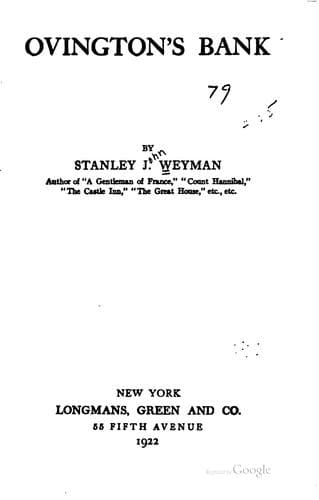
Banks and banking -- Fiction; England -- Social life and customs -- 19th century -- Fiction; Love stories
She watched him go with his heavy burden and his blunt common-sense
down the garden walk; and when he had disappeared behind the pear-tree
espaliers she went back to listen outside the parlor door. She had been
her father’s pet. He had treated her with an indulgence and a
familiarity rare in those days of parental strictness, and she
understood him well, better than others, better even than Clement. She
knew what failure would mean to him. It was not the loss of wealth
which would wound him most sorely, though he would feel that; but the
loss of the position which success had gained for him in the little
world in which he lived, and lived somewhat aloof. He had been thought,
and he had thought himself, cleverer than his neighbors. He had borne
himself as one belonging to, and destined for, a wider sphere. He had
met the pride of the better-born and the older-established with a
greater pride; and believing in his star, he had allowed his contempt
for others and his superiority to be a little too clearly seen.
For all this he would now pay, and his pride would suffer. Betty,
lingering in the darker part of the hall, where the servants could not
spy on her, listened and longed to go in to him and comfort him. But
all the rules forbade this, she might not distract him at such a time.
Yet, had she known how deep was his depression as he sat sunk in his
chair, had she known how the past mocked him, and the long chain of his
successes rose and derided him, how the mirage of long-cherished hopes
melted and left all cold before him—had she guessed the full bitterness
of his spirit, she had broken through every rule and gone in to him.
The self-made man! Proudly, disdainfully he had flung the taunt back in
men’s faces. Could they make, could they have made themselves, as he
had? And now the self-ruined man! He sat thinking of it, and the
minutes went by. Twice one of the clerks came in and silently placed a
slip beside him and went softly out. He looked at the slip, but without
taking in its meaning. What did it matter whether a few more or a few
less pounds had been drawn out, whether the drain had waxed or waned in
the last quarter of an hour? The end was certain, and it would come
when the two men arrived on the Chester coach. Then he would have to
bestir himself. Then he would have to resume the lead and play the man,
give back hardness for hardness and scorn for scorn, and bear himself
so in defeat that no man should pity him. And he knew that he could do
it. He knew that when the time came his voice would be firm and his
face would be granite, and that he would pronounce his own sentence and
declare the bank closed with a high head. He knew that even in defeat
he could so clothe himself with power that no man should browbeat him.
Public-domain text, read in full here on John Shaqi.
Reviews
Reviews
No reviews yet
Be the first to share your thoughts on this work.
Elsewhere in the archive
Join the Discussion
Join the discussion
Sign in to leave a comment or review.
Sign InorCreate an account