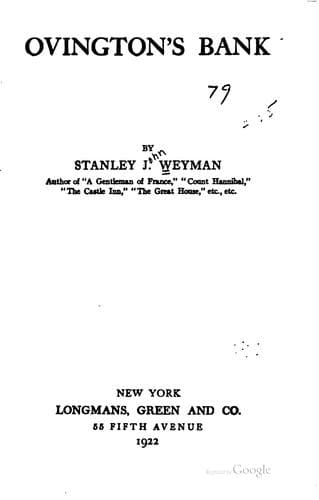
Banks and banking -- Fiction; England -- Social life and customs -- 19th century -- Fiction; Love stories
The two marched out with that, but the Squire’s words ran up and down
the town like wild-fire. What he had said and how he had said it, and
the figure little Tom Jenkins of the Hollies had cut, was known as far
as the Castle Foregate before the old man had well set his foot on the
step of his carriage. The crowd standing about Sir Charles’s four bays
in the Market Place and respectfully gazing on the postillions’ yellow
jackets had it within two minutes. Within four it was known at the
Gullet that the old Squire was supporting the bank, and had given Welsh
Owen such a talking-to as never was. Within ten, the news was being
bandied up and down the long yard at the Lion, where they stabled a
hundred horses, and was known even to the charwomen who, on their
knees, were scrubbing the floors of the Assembly Rooms that looked down
on the yard. Dean’s, at which a persistent and provoking run had been
prosecuted since morning, got it among the first; and Mr. Dean, testy
and snappish enough before, became for the rest of the day a terror and
a thunder-cloud to the junior clerks. Nay, the news soon passed beyond
Aldersbury, for the three o’clock up-coach swept it away and dropped it
with various parcels and hampers at every stage between the Falcon at
Heygate and Wolverhampton. Not a turn-pike man but heard it and spread
it, and at the Cock at Wellington they gave it to the down-coach, which
carried it back to Aldersbury.
Owen, it was known, had drawn his money. But Jenkins had thought better
of it. He had gone out of the bank with his cheque in his hand, and had
torn it up _coram public_ in the roadway; and from that moment the run,
its force already exhausted, had ceased. Half an hour later he would
have been held a fool who looked twice at an Ovington note, or
distrusted a bank into which, rumor had it, gold had been carried by
the sackful. Had not the Bank of England sent down a special messenger
bearing unstinted credit? And had not the old Squire of Garth, the
closest, stingiest, shrewdest man in the county, paid in thirty, forty,
fifty thousand pounds and declared that he would sell every acre before
the bank should fail? Before night a dozen men were considering
ruefully the thing that they had done or pondering how they might, with
the least loss of dignity, undo it. Before morning twice as many wives
had told their husbands what they thought of them, and reminded them
that they had always said how it would be—only they were never listened
to!
Public-domain text, read in full here on John Shaqi.
Reviews
Reviews
No reviews yet
Be the first to share your thoughts on this work.
Elsewhere in the archive
Join the Discussion
Join the discussion
Sign in to leave a comment or review.
Sign InorCreate an account