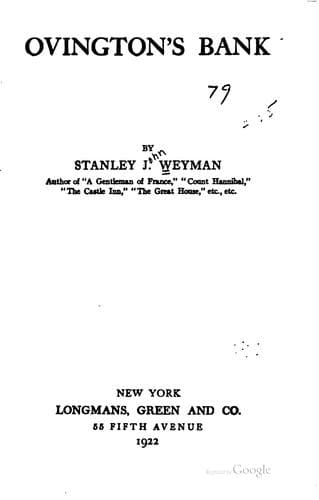
Banks and banking -- Fiction; England -- Social life and customs -- 19th century -- Fiction; Love stories
“You’ll never do that,” said the old man sternly, as he bent lower over
his stick. He heard the door close and he knew that Clement had
gone—gone on wings, gone on feet lighter than thistle-down, gone, young
and strong, his pulses leaping, to his love.
The Squire was too old for tears, but his lip trembled. It was not
alone the sacrifice that he had made that moved him—the sacrifice of
his pride, his prejudices, his traditions. It was not only the
immolation of his own will, his hopes and plans—his cherished plans for
her. But he was giving her up. He was resigning that of which he had
only just learned the worth, that on which in his blindness he depended
every hour, that which made up all of youth and brightness and
cheerfulness that was left to him between this and the end. He had sent
the man to her, and they would think no more of him. And in doing this
he had belied every belief in which he had been brought up and the
faith which he had inherited from an earlier day—and maybe he had been
a fool!
But by and by it appeared that they had not forgotten him, or one, at
any rate, had not. He had not been alone five minutes before the door
opened behind him, and closed again, and he felt Josina’s arms round
his neck, her head on his breast. “Oh, father, I know, I know,” she
cried. “I know what you have done for me! And I shall never forget
it—never! And he is good. Oh, father, indeed, indeed, he is good!”
“There, there,” he said, stroking her head. “Go back to him. But, mind
you,” hurriedly, “I don’t promise anything yet. In a year, maybe, I’ll
talk about it.”
THE END
Public-domain text, read in full here on John Shaqi.
Reviews
Reviews
No reviews yet
Be the first to share your thoughts on this work.
Elsewhere in the archive
Join the Discussion
Join the discussion
Sign in to leave a comment or review.
Sign InorCreate an account