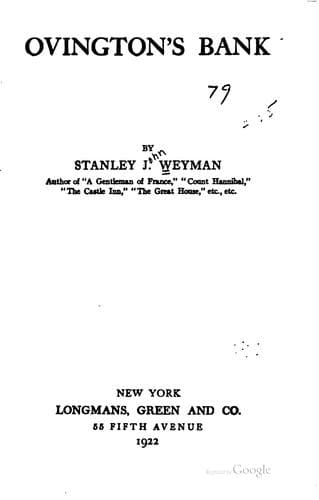
Banks and banking -- Fiction; England -- Social life and customs -- 19th century -- Fiction; Love stories
“You’re neither to see him nor speak to him nor listen to him! There’s
to be an end of it. Now, are you going to obey me, girl?”
She looked as if butter would not melt in her mouth. “Yes, sir,” she
answered meekly. “I shall obey you if those are your orders.”
He was surprised by the readiness of her assent, and he looked at her
suspiciously. “Umph!” he grunted. “That sounds well, and it will be
well for you, girl, if you keep to it. For I mean it. Let there be no
mistake about that.”
“I shall do as you wish, of course, sir.”
“He’s behaved badly, d—d badly! But if you are sensible I’ll say no
more. Only understand me, you’ve got to give him up.”
“Yes, sir.”
“From this day? Now, do you understand?”
“Yes, sir.”
After that he had no more to say. He required obedience, and he should
have been glad to receive it. But, to tell the truth, he was a little
at a loss. Girls were silly—such was his creed—and it behoved them to
be guided by their elders. If they did not suffer themselves to be
guided, they must be brought into line sharply. But somewhere, far down
in the old man’s heart, and unacknowledged even by himself, lay an odd
feeling—a feeling of something like disappointment. In his young days
girls had not been so ready, so very ready, to surrender their lovers.
He had even known them to fight for them. He was perplexed.
CHAPTER X
They were standing on the narrow strip of sward between the wood and
the stream, which the gun accident had for ever made memorable to them.
The stile rose between them, but seeing that his hands rested on hers,
and his eyes dwelt unrebuked on her conscious face, the barrier was but
as the equator, which divides but does not separate; the sacrifice to
propriety was less than it seemed. Spring had come with a rush, the
hedges were everywhere bursting into leaf. In the Thirty Acres which
climbed the hill above them, the thrushes were singing their May-day
song, and beside them the brook rippled and sparkled in the sunshine.
All Nature rejoiced, and the pulse of youth leapt to the universal
rhythm. The maiden’s eyes repeated what the man’s lips uttered, and for
the time to love and to be loved was all in all.
“To think,” he murmured, “that if I had not been so awkward we should
not have known one another!” And, silly man, he thought this the height
of wisdom.
“And the snowdrops!” She, alas, was on the same plane of sapience. “But
when—when did you first, Clem?”
“From the first moment we met! From the very first, Jos!”
“When I saw you standing here? And looking——”
“Oh, from long before that!” he declared. And his eyes challenged
denial. “From the hour when I saw you at the Race Ball in the Assembly
Room—ages, ages ago!”
She savored the thought and found it delicious, and she longed to hear
it repeated. “But you did not know me then. How could you—love me?”
Public-domain text, read in full here on John Shaqi.
Reviews
Reviews
No reviews yet
Be the first to share your thoughts on this work.
Join the Discussion
Join the discussion
Sign in to leave a comment or review.
Sign InorCreate an account