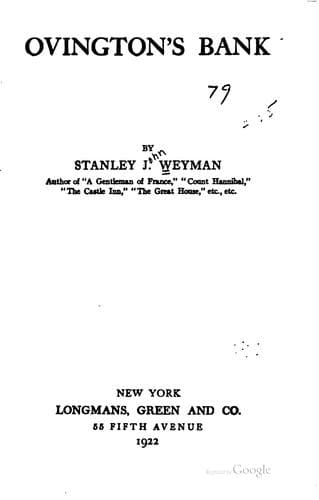
Banks and banking -- Fiction; England -- Social life and customs -- 19th century -- Fiction; Love stories
“Mebbe in malt, but not in meal. In money, mebbe—I’m not saying a
little more, master. But here’s where ’tis. We’d the common before the
war, and run for a cow and geese, and wood for the picking, and if a
lad fancied to put up a hut on the waste ’twas five shillings a year;
and a rood o’ potato ground—it wasn’t missed. ’Twas neither here nor
there. But ’tisn’t so now. Where be the common? Well, you know, Squire,
laid down in wheat these twenty years, and if a lad squatted now, he’d
not be long of hearing of it. We’ve the money, but we’re not so well
off. That’s where ’tis.”
The Squire scowled. “Well, I’m d—d!” he said. “You’ve been with me
fifty years, and——” and then fortunately or unfortunately the curricle
came round and the Squire, despising Fewtrell’s hint, turned his wrath
upon the groom, called him a lazy scoundrel, and cursed him up hill and
down dale.
The man took it in silence, to the bailiff’s surprise, but his sullen
face did not augur well for the day, and when he had climbed to the
back-seat—with a scramble and a grazed knee, for the Squire started the
horses with no thought for him—he shook his fist at the old man’s back.
Fewtrell saw the gesture, and felt a vague uneasiness, for he had heard
Thomas say ugly things. But then the man had been in liquor, and
probably he didn’t mean them.
The Squire rattled the horses down the steep drive with the confidence
of one who had done the same thing a thousand times. Turning to the
left a furlong beyond the gate, he made for Garthmyle where, at the
bridge, he fell into the highway. He had driven a mile along this when
he saw a horseman coming along the road to meet him, and he fell to
wondering who it was. His sight was good at a distance, and he fancied
that he had seen the young spark before, though he could not put a name
to him. But he saw that he rode a good nag, and he was not surprised
when the other reined up and, raising his hat, showed that he wished to
speak.
It was Clement, of course, and with a little more wisdom or a little
less courage he would not have stopped the old man. He would have seen
that the moment was not propitious, and that his business could hardly
be done on the highway. But in his intense eagerness to set himself
right, and his anxiety lest chance should forestall him, he dared not
let the opportunity pass, and his hand was raised before he had well
considered what he would say.
The Squire pulled up his horses. “D’you want me?” he asked, civilly
enough.
“If I may trouble you, sir,” Clement answered as bravely as he could.
“It’s on important business, or—or I wouldn’t detain you.” Already, his
heart in his mouth, he saw the difficulty in which he had placed
himself. How could he speak before the man? Or on the road?
The Squire considered him. “Business, eh?” he said. “With me? Well, I
know your face, young gentleman, but I can’t put a name to you.”
“I am Mr. Ovington’s son, Clement Ovington, sir.”
Public-domain text, read in full here on John Shaqi.
Reviews
Reviews
No reviews yet
Be the first to share your thoughts on this work.
Elsewhere in the archive
Join the Discussion
Join the discussion
Sign in to leave a comment or review.
Sign InorCreate an account