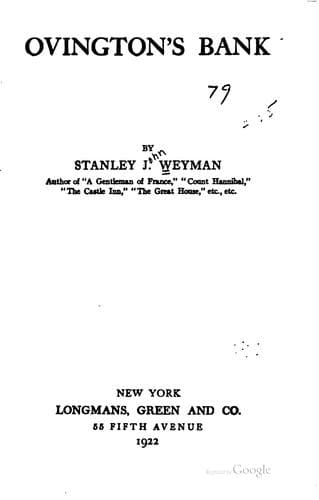
Banks and banking -- Fiction; England -- Social life and customs -- 19th century -- Fiction; Love stories
“Hang the man! Where is he?” the Squire muttered, looking about him
with a disgusted eye, and wishing himself at home. “Where is the
rogue?”
Then Thomas, driving slowly and orating to a couple of men who walked
beside the carriage, came into view. The Squire roared at him, and
Thomas, taken by surprise, whipped up his horses so sharply that he
knocked over a hawker’s basket. Still storming at him the old man
climbed to his seat and took the reins. He drove round the corner into
Bride Hill, and stopped at Purslow’s door.
The draper was at the carriage wheel before it stopped. He had the bag
in his hand, but he did not at once hand it up. “Excuse me, excuse the
liberty, sir,” he said, lowering his voice and glancing at Thomas, “but
it’s a large sum, sir, and it’s late. Hadn’t I better keep it till
morning?”
The Squire snapped at him. “Morning? Rubbish, man! Put it in.” He made
room for the bag at his feet.
But the draper still hesitated. “It will be dark in ten minutes, sir,
and the road—it’s true, no one has been stopped of late, but——”
“I’ve never been stopped in my life,” the Squire rejoined. “Put it in,
man, and don’t be a fool. Who’s to stop me between here and Garth?”
Purslow muttered something about the safe side, but he complied. He
handed in the bag, which gave out a clinking sound as it settled itself
beside the Squire’s feet. The old man nodded his thanks and started his
horses.
He drove down Bride Hill, and by the Stalls, where the taps were
humming, and the inns were doing a great business. Passing one or two
belated carts, he turned to the right and descended to the bridge, the
old houses with their galleries and gables looming above him as for
three centuries they had loomed above the traveller by the Welsh road.
He rumbled over the bridge, the wide river flowing dark below him. Then
he trotted sharply up Westwell, passing by the inns that in old days
had served those who arrived after the gates were closed.
Now he faced the open country and the wet west wind, and he settled
himself down in his seat and shook up his horses. As he did so his foot
touched the bag, and again the gold gave out a clinking sound.
CHAPTER XIII
The Squire in his inmost heart had not derived much satisfaction from
his visit to the bank. He had left it with an uneasy feeling that the
step he had taken had not produced the intended effect. Ovington had
accepted the loss of his custom, not indeed with indifference, but with
dignity, and in a manner which left the old man little upon which to
plume himself. The withdrawal of his custom wore in the retrospect too
much of the look of spite, and he came near to regretting it, as he
drove along.
Public-domain text, read in full here on John Shaqi.
Reviews
Reviews
No reviews yet
Be the first to share your thoughts on this work.
Elsewhere in the archive
Join the Discussion
Join the discussion
Sign in to leave a comment or review.
Sign InorCreate an account