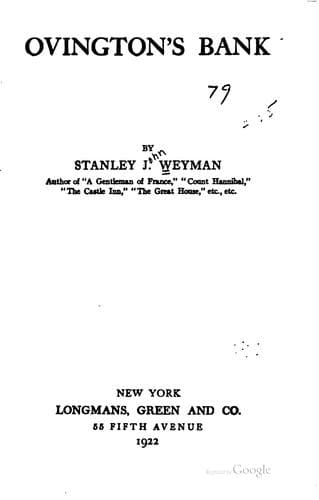
Banks and banking -- Fiction; England -- Social life and customs -- 19th century -- Fiction; Love stories
The banker reflected. “That’s the worst account we have. The worst,
isn’t it?”
“Mr. Acherley’s, sir.”
“Well, yes. There might be a sounder account than that. But what is
it?” He looked directly at the other. “I want to know what has opened
your mouth? Have you heard anything? What makes you think that things
are going down?”
“Mr. Griffin——”
“No.” The banker shook his head. “That won’t do, Rodd. You had this in
your mind before he came in. You are pat with Wolley and Mr. Acherley;
bad accounts both, as all banks have bad accounts here and there. But
it’s true—we’ve been giving our customers rope, and they have bought
things that may fall. Still, they’ve made money, a good deal of money,
and we’ve kept a fair margin and obliged them at the same time. All
legitimate business. There must be something in your mind besides this,
I’m sure. What is it, lad?”
The cashier turned a dull red, but before he could answer the door
behind him opened. Arthur came in. He looked at the banker, and from
him to Rodd, and his suspicions were aroused. “It’s four o’clock, sir,”
he said, and looked again at Rodd as if to ask what he was doing there.
But Rodd held his ground, and the banker explained.
“Rodd is a little alarmed for us,” he said, and it was difficult to be
sure whether he spoke in jest or in earnest. “He thinks we’re going too
fast. Putting our hand out too far. He mentions Wolley’s account, and
Acherley’s.
“I was speaking generally,” Rodd muttered. He looked sullen.
Arthur shrugged his shoulders. “I stand corrected,” he said. “I didn’t
know that Rodd ever went beyond his ledgers.”
“Oh, he’s quite right to speak his mind. We are all in the same
boat—though we do not all steer.”
“Well, I’m glad of that, sir.”
“Still,” mildly, “it is a good thing to have an opinion.”
“If it be worth anything.”
“If opinions are going——” Betty had opened the door behind the banker’s
chair, and was standing on the threshold—“wouldn’t you like to have
mine, father?”
“To be sure,” Arthur said. “Why not, indeed? Let us have it. Why not
have everybody’s? And send for the cook, sir, and the two clerks—to
advise us?”
Betty dropped a curtsy. “Thank you, I am flattered.”
“Betty, you’ve no business here,” her father said. “You mustn’t stop
unless you can keep your opinions to yourself.”
“But what has happened?” she asked, looking around in wonder.
“Mr. Griffin has withdrawn his account.”
“And Rodd,” Arthur added, with more heat than the occasion seemed to
demand, “thinks that we had better put up the shutters!”
“No, no,” the banker said. “We must do him justice. He thinks that we
are going a little too far, that’s all. And that the loss of Mr.
Griffin’s account is a danger signal. That’s what you mean, man, isn’t
it?”
Rodd nodded, his face stubborn. He stood alone, divided from the other
three by the table, for Arthur had passed round it and placed himself
at Ovington’s elbow.
Public-domain text, read in full here on John Shaqi.
Reviews
Reviews
No reviews yet
Be the first to share your thoughts on this work.
Elsewhere in the archive
Join the Discussion
Join the discussion
Sign in to leave a comment or review.
Sign InorCreate an account