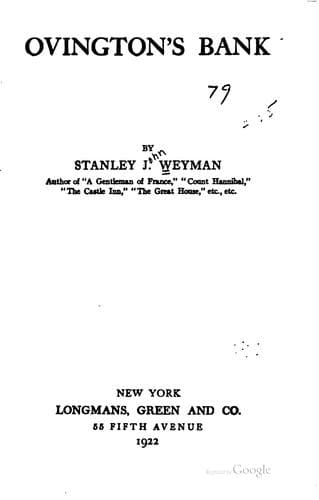
Banks and banking -- Fiction; England -- Social life and customs -- 19th century -- Fiction; Love stories
Clement was unwilling to go, unwilling to have no farther part in the
matter. But he could not refuse. Things were as they were; in spite of
all that he had done and suffered, he had no place there, no standing
in the house, no right beside his mistress or call to think for her. He
was a stranger, an outsider, and when he had fetched the doctor, there
would, as Arthur had said, be nothing more that he could do.
Nothing more, though as he rode over the bridge and trotted through the
village his heart was bursting with pity for her whom he could not
comfort, could not see; from whose side in her troubles and her
self-arraignment—for he knew that she would reproach herself—he must be
banished. It was hard.
CHAPTER XV
The Squire was late.
A hundred years ago night fell more seriously. It closed in on a
countryside less peopled, on houses and hamlets more distant, and
divided by greater risks of flood and field. The dark hours were longer
and haunted by graver apprehensions. Every journey had to be made on
horses or behind them, roads were rough and miry, fords were plenty,
bridges scarce. Sturdy rogues abounded, and to double every peril it
was still the habit of most men to drink deep. Few returned sober from
market, fewer from fair or merry-making.
For many, therefore, the coming of night meant the coming of fear.
Children, watching the great moths fluttering against the low ceiling,
or round the rush-light that cast such gloomy shadows, thought that
their elders would never come upstairs to bed. Lone women, quaking in
remote dwellings, remembered the gibbet where the treacherous
inn-keeper still moulded, and fancied every creak the coming of a man
in a crape mask. Thousands suffered nightly because the goodman
lingered abroad, or the son was absent, and in many a window the light
was set at dusk to guide the master by the pool. On market evenings
women stole trembling down the lane that the sound of wheels might the
sooner dispel their fears.
At Garth it was youth not age that first caught the alarm. For Josina’s
conscience troubled her, and before even Miss Peacock, most fidgety of
old maids, had seen cause to fear, the girl was standing in the
darkness before the door, listening and uneasy. The Squire was seldom
late; it could not be that Clement had met him and there had been a—but
no, Clement was not the man to raise his hand against his elder—the
thought was dismissed as soon as formed. Yet why did not the Squire
come? Lights began to shine through the casements, she saw the candles
brought into the dining-room, the darkness thickened about her, only
the trunks of the nearer beeches gave back a gleam. And she felt that
if anything had happened to him she could never forgive herself.
Shivering, less with cold than with apprehension, she peered down the
drive. He had been later than this before, but then her conscience had
been quiet, she had not deceived him, she had had nothing with which to
reproach herself on his account.
Public-domain text, read in full here on John Shaqi.
Reviews
Reviews
No reviews yet
Be the first to share your thoughts on this work.
Elsewhere in the archive
Join the Discussion
Join the discussion
Sign in to leave a comment or review.
Sign InorCreate an account