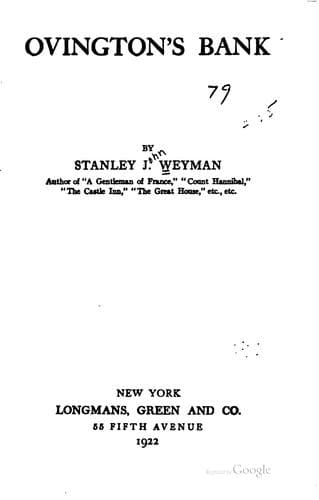
Banks and banking -- Fiction; England -- Social life and customs -- 19th century -- Fiction; Love stories
“Send him, Calamy,” said Josina.
Calamy retired. Miss Peacock looked out, a shawl about her head. “Jos!
Where are you?” she cried. “Come in at once, girl. Do you think I am
going to be left alone, and the door open? Jos! Jos!”
But Josina was gone, groping her way down the drive. When Fewtrell
followed with his lanthorn he came on her sitting on the bridge, and he
got a rare start, thinking it was a ghost. “Lord A’mighty!” he cried as
the light fell on her pale face. “Aren’t you afraid to sit there by
yourself, miss?”
But Josina was not afraid, and after a word or two he shambled away,
the lanthorn swinging in his hand. The girl watched the light go
bobbing along as far the highway fifty yards on, saw it travel to the
left along the road, lost it for some moments, then marked it again, a
faint blur of light, moving towards the village.
Presently it vanished and she was left alone with her fears. She
strained her ears to catch the first sound of wheels. The stream
murmured beneath her, a sick sheep coughed, the breeze whispered in the
hedges, the cry of an owl, thrice repeated, sank into silence. But that
was all, and in the presence of the silent world about her, of the
all-enveloping night, of the solemn stars shining as they had shone
from eternity, the girl knew herself infinitely helpless, without
remedy against the stroke of impending fate. She recognized that
lighted rooms and glowing fires and the indoor life did but deceive;
that they did but blind the mind to the immensity of things, to the
real issues, to life and death and eternity. Anguished, she owned that
a good conscience was the only refuge, and that she had it not. She had
deceived her father, and it would be her fate to endure a lasting
remorse. At last, her eyes opened, she fancied that she detected behind
the mask a father’s face. But too late, for the bridge which he had
crossed innumerable times, the drive, rough and rutted, yet the
harbinger of home, which he had climbed from boyhood to age, the
threshold which he had trodden so often as master—they would know him
no more! At the thought she broke down and wept, feeling all its
poignancy, all its pitifulness, and finding for the moment no support
in Clement, no recompense in a love which deceit and secrecy had
tainted.
Public-domain text, read in full here on John Shaqi.
Reviews
Reviews
No reviews yet
Be the first to share your thoughts on this work.
Elsewhere in the archive
Join the Discussion
Join the discussion
Sign in to leave a comment or review.
Sign InorCreate an account