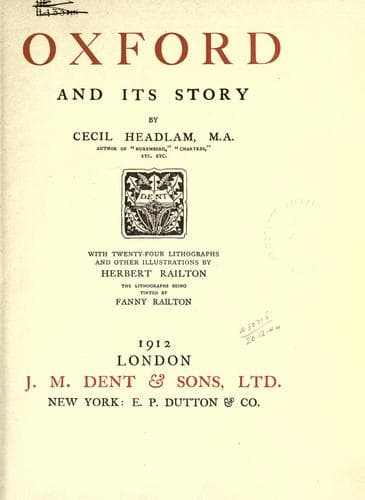
Oxford (England) -- History; University of Oxford -- History
For all great civilians were ecclesiastics. The Church embraced all the
professions; and the professors of all arts, of medicine, statesmanship
or architecture, of diplomacy and even of law, embraced the Church. And
the reward of success in any of them was ecclesiastical promotion and a
fat benefice. The University opened the door to the Church, with all its
dazzling possibilities of preferment, and the University itself was
thrown open to the poorest by the system of the monastic houses and
charitable foundations.
Promising lads, too, of humble origin were often maintained at the
schools by wealthy patrons. From a villein one might rise to be a clerk,
from a clerk become a master of the University--a fellow, a bursar, a
bishop and a chancellor, first of Oxford, then of England.
At the University, of course, the students were not treated with the
same absolute equality that they are now, regardless of birth or wealth.
Sons of noblemen did not study there, unless they had a strong bent in
that direction. The days were not yet come when a University training
was valuable as a social and moral as well as an intellectual education:
when noblemen, therefore, did attend the schools, more was made of them.
They wore hoods lined with rich fur, and enjoyed certain privileges with
regard to the taking of degrees.
Like those idyllic islanders who lived by taking in each other's
washing, the masters supported themselves on the fees paid by the
students who attended their lectures, whilst the poorest students earned
a livelihood by waiting on the masters, or wealthier students.
Servitors, who thus combined the careers of undergraduates with those of
"scouts," continued in existence till the end of the eighteenth century.
They were sent on the most menial errands or employed to transcribe
manuscripts, and five shillings was deemed an ample allowance for their
services. Whitfield was a servitor, and the father of the Wesleys also.
Such students, lads of low extraction, drawn from the tap-room or the
plough, but of promising parts, would be helped by the chests which we
have described, and which were founded for their benefit. When Long
Vacation came, they would turn again from intellectual to manual labour.
For Long Vacation meant for them, not reading-parties, but the harvest,
and in the harvest they could earn wages. But there was another method
of obtaining the means to attend lectures at the University which was
popularised in the Middle Ages by the Mendicants, by the theory of the
poverty of Christ and by the insistence of the Church on the duty of
charity. This was begging on the highway. "Pain por Dieu aus escoliers"
was a well-known "street cry" in mediæval Paris, and in England during
vacations the wandering scholar,
"Often, starting from some covert place,
Saluted the chance comer on the road,
Crying, 'An obolus, a penny give
To a poor scholar.'"
Public-domain text, read in full here on John Shaqi.
Reviews
Reviews
No reviews yet
Be the first to share your thoughts on this work.
Elsewhere in the archive
Join the Discussion
Join the discussion
Sign in to leave a comment or review.
Sign InorCreate an account