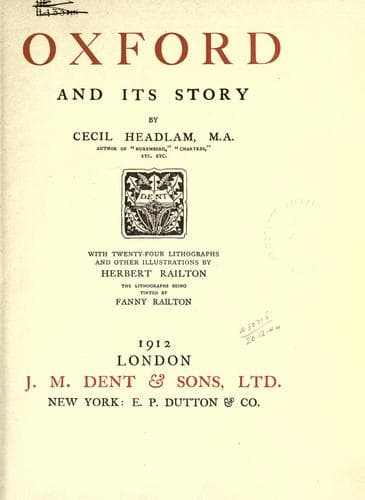
Oxford (England) -- History; University of Oxford -- History
It remained to construct an upper story where the books belonging to the
University might be kept and used. For generous gifts of books
(1439-1446) by Humphrey, Duke of Gloucester, uncle of Henry VI., had
greatly increased the University Library. The fashion of large and
gorgeous libraries was borrowed by the English from the French princes.
The duke had taken his opportunity during his campaigns in France. He
seized the valuable collection of books at the Louvre, and many of them
had now found their way to Oxford. They were stored at first in the
Cobham Library, but more room was needed. Accordingly, in 1444, the
University addressed a letter to the duke in which they informed him of
their intention to erect a new building suitable to contain his
magnificent gift, and on a site far removed from the hum of men. Of this
building, with that gratitude which is in part at least a lively sense
of favours to come, they asked permission of the very learned and
accomplished duke to inscribe his name as founder. The Duke Humphrey
Library forms now the central portion of the great Reading Room of the
Bodleian Library. It still answers, by virtue of its position and the
arrangement of its cubicles, to the description and intention of the
promotors--to build a room where scholars might study far removed _a
strepitu sæculari_, from the noise of the world.
The three wheat-sheaves of the Kempe shield, repeated again and again on
the elaborate groined roof of the Divinity School, commemorate the
bounty of Thomas Kempe, Bishop of London, who (1478) promised to give
1000 marks for the completion of the school and the library. A grateful
University rewarded him with anniversary services; his name is still
mentioned in the "bidding prayer" on solemn occasions. Nor was Duke
Humphrey forgotten. His name still heads the list of benefactors recited
from time to time in S. Mary's. Religious services were instituted also
for his benefit. He was more in need of them, perhaps, than the bishop.
For the "Good Duke Humphrey" was good only so far as his love of
learning and his generosity to scholars may entitle him to be considered
so. The patron of Lydgate and Occleve, and the donor of hundreds of rare
and polite books to the University was as unscrupulous in his political
intrigues as immoral in his private life. But in his case the good he
did lived after him.
The "Good Duke" was a reader as well as a collector. It was not merely
the outsides of books or the title-pages which attracted him.
"His courage never doth appal
To study in books of antiquity."
Public-domain text, read in full here on John Shaqi.
Reviews
Reviews
No reviews yet
Be the first to share your thoughts on this work.
Elsewhere in the archive
Join the Discussion
Join the discussion
Sign in to leave a comment or review.
Sign InorCreate an account