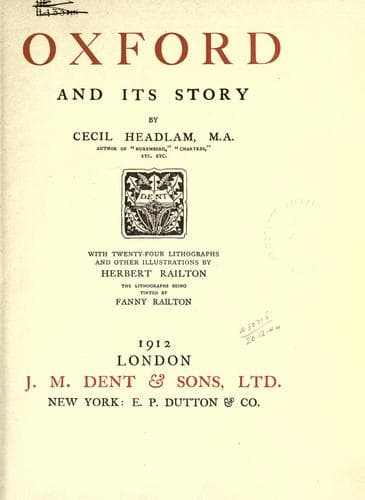
Oxford (England) -- History; University of Oxford -- History
In 1630 he was elected Chancellor in opposition to the younger brother
of the late Chancellor, Lord Pembroke, who was supported by the
Calvinists. Preaching on the points in dispute between Calvin and
Arminius was at once forbidden. This, with Laud as Chancellor, meant
that the Puritans, who regarded Laud's "High Church" views as little
better than Popery in disguise and as exposing the country to a danger
which was too near and too deadly to be trifled with, were muzzled or
driven from the country; but their opponents, if they preached against
the practices of Geneva, met only with the mildest kind of rebuke.
Laud's experience of the University had convinced him of the necessity
of revising and codifying the statutes "which had long lain in a
confused heap." As Chancellor he at once set about that difficult task.
The Caroline or Laudian Statutes were based on the old statutes and
customs as collected, transcribed and drawn up by the antiquarian, Brian
Twyne, fellow of C.C.C. Laud rewarded him with the office of Custos
Archivorum. It was from the vast and scholarly collections of Brian
Twyne that Wood quarried freely, and, it must be said, without due
acknowledgment. But Wood succeeded in a task beyond Twyne's powers. He
achieved immortality by clothing the dry bones of antiquarian fact or
fancy in prose at times so racy and at times so musical.
Already (1629) Laud had been responsible for the introduction of the
cycle, which put an end to the riots that had hitherto attended the
election of proctors. Free election by the academical democracy had
resulted in frequent abuses. The cycle invented
[Illustration: Oriel Window S. John's College]
by Peter Turner of Merton assigned to each college in turn, and in
proportion to its size and dignity, the right of nominating proctors.
The system, modified in 1856 and 1887, still obtains. His care for
discipline led the Chancellor to make some much-needed reforms in the
direction of diminishing the number of ale-houses and enforcing a proper
system of licensing in the town. By his own proclamation he named a
toll-gatherer for the market; he obtained an order from Council for the
destruction of cottages which the townsmen had erected round about the
wall and ditch; and, in spite of a protest from the citizens, the
Caroline Charter was obtained, confirming the rights of the University
over the town.
Public-domain text, read in full here on John Shaqi.
Reviews
Reviews
No reviews yet
Be the first to share your thoughts on this work.
Elsewhere in the archive
Join the Discussion
Join the discussion
Sign in to leave a comment or review.
Sign InorCreate an account