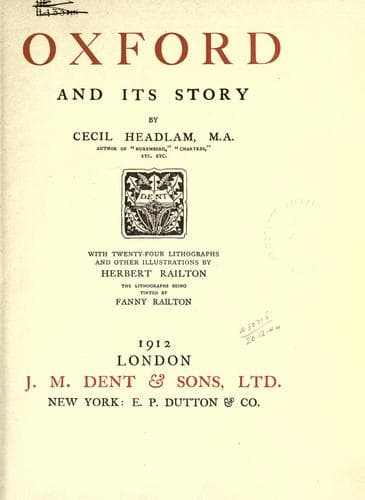
Oxford (England) -- History; University of Oxford -- History
The University fought every inch of the ground, standing firmly on the
vantage ground of constitutional right. But the gown usually has to
yield to arms. New Heads were appointed, new M.A.'s created, and the
Visitors proceeded to purge the colleges. Every fellow, student and
servant was asked, "Do you submit to the authority of Parliament in this
present Visitation?" Those who did not submit were turned out. Presently
the Negative Oath was tendered, and subscription to "the Engagement" was
required. Rather than submit to these tests over four hundred fellows
preferred to be ejected. Puritans, men for the most part of real
learning and piety, were substituted, though those who suffered
described "the new plantation of saints" as an illiterate rabble, "swept
up from the plough-tail and scraped out of Cambridge."
At New College a very large proportion of the fellows were expelled:
fifty at the lowest computation. The inquisition even extended its
investigations to the college servants. The organist, sexton,
under-butler, manciple, porter, groom and basket bearer were all outed,
when they could not in conscience submit. At Merton Wood refused to
answer, but by the goodwill of the warden and Arch Visitor, a friend of
his mother, "A. W. was connived at and kept in his place, otherwise he
had infallibly gone to the pot."
The Visitors acted, on the whole, in the spirit of genuine reformers.
Apart from imposing a system of Puritan morals, they worked with a
sincere desire to make the colleges fruitful nurseries of learning. What
they did, and still more what they wished to do, with regard to the
discipline of the place was on the right lines of educational advance.
In July an attempt was made to recapture the guard and magazine in New
College. The conspiracy was revealed by a boozing and boastful
conspirator. Two years later a mutiny of the garrison, in protest
against excise, tithes and lawyers, was checked by the vigilance of
Colonel Ingoldsby, the governor.
Fairfax and Cromwell visited Oxford to see how the reformation was
progressing (17th May 1649), and lodged at All Souls'. They dined at
Magdalen, where they had "good cheer and bad speeches, and afterwards
played at bowls in the College Green." They both received a D.C.L.
degree, and Cromwell assured the University that he meant to encourage
learning. Next year he became Chancellor, and besides presenting some
MSS. he resisted the proposal to reduce the academical endowments which
Milton supported.
Public-domain text, read in full here on John Shaqi.
Reviews
Reviews
No reviews yet
Be the first to share your thoughts on this work.
Elsewhere in the archive
Join the Discussion
Join the discussion
Sign in to leave a comment or review.
Sign InorCreate an account