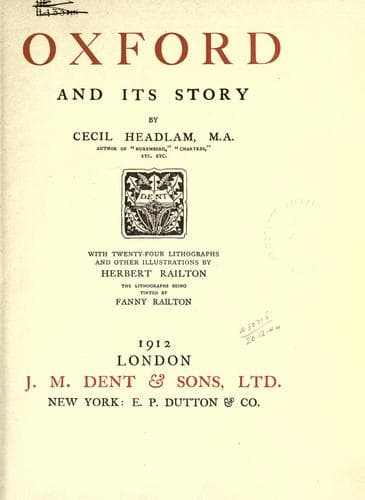
Oxford (England) -- History; University of Oxford -- History
"informed them of the mischiefs of that hellish liquor called ale.
But one of them, not willing to be preached so tamely out of his
beloved liquor, made reply that the Vice-Chancellor's men drank ale
at the Split Crow and why should they not too? The old man, being
nonplussed with this reply, immediately packeth away to the
Vice-Chancellor, formerly an old lover of ale himself,"
who informed him that there was no hurt in ale. Accordingly the master
told his men that since the Vice-Chancellor said there was no hurt in
ale, though truly he thought there was, he would give them leave to
drink it. "So now," Prideaux concludes, "they may be sots by authority."
In 1682, Wood notes, "fighting occasioned by drunkenness fell out in S.
John's common chamber." Common rooms, it may be observed, which were
regarded as a luxurious innovation, had been introduced into Oxford in
1661 by Merton, where the room over the kitchen, with the cock-loft over
it, was turned into a room "for the common use of the Fellows." Other
colleges quickly followed an example which had been set eleven years
before in the Combination Room of Trinity at Cambridge.
The accession of James II. was hailed at Oxford with many expressions of
loyalty. A large bonfire was lit at Carfax and five barrels of beer
broached in the Town Hall, to be drunk by all comers. There were
bonfires in all the colleges, where the respective societies drank a
health, kneeling, to the King and Royal Family. At Merton, Wood tells
us, "the gravest and greatest seniors of the house were mellow that
night, as at other Colleges." And the coronation was celebrated by a
sermon and bonfire at S. Mary's and "great extraordinaries in eating and
drinking in each College." But there were many townsmen who had been
ready (1683) to shout for "a Monmouth! a Monmouth! no York!" and after
Monmouth's Rebellion, when the University raised a regiment, whose
uniforms at any rate were gallant, several of the citizens were arrested
as rebels. It was not long before the bigotry and tyranny of James drove
the University itself into that resistance to the royal authority which
was so alien to its teaching and tradition. For James set himself to
convert the training-place of the English clergy into a Roman Catholic
seminary.
Public-domain text, read in full here on John Shaqi.
Reviews
Reviews
No reviews yet
Be the first to share your thoughts on this work.
Elsewhere in the archive
Join the Discussion
Join the discussion
Sign in to leave a comment or review.
Sign InorCreate an account