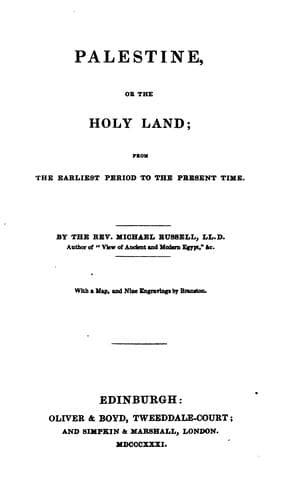
Palestine, or, the Holy Land: From the Earliest Period to the Present TimeRussell, Michael
History
Palestine, or, the Holy Land: From the Earliest Period to the Present Time
Russell, Michael
Palestine -- Description and travel; Palestine -- History
On this occasion a camp of Turkish horse, with all the accompaniments of
oriental pomp, was pitched under the walls. The tents in general were
covered with black lambskins, while those belonging to persons of
distinction were formed of striped cloth. The horses, saddled and bridled,
were fastened to stakes. There were four pieces of horse-artillery, well
mounted on carriages, which appeared to be of English manufacture. These
fierce soldiers are stationed near the capital, as well for the purpose of
checking the savage Bedouins, who acknowledge no master, as for enforcing
the tribute demanded from all strangers who enter the holy city. The
recollections of the Mussulman, no less than those of the Christian,
inspire a reverential feeling for the town in which David dwelt; and
hence, although the European pilgrim be oppressed by the present laws of
Palestine, his motives are usually respected, and even praised.
The reader who has perused with attention some of the more recent works on
Palestine must have been struck with the diversity, and even the apparent
contradiction, which prevail in their descriptions of Jerusalem. According
to one, the magnificence of its buildings rivals the most splendid
edifices of modern times, while another could perceive nothing but filth
and ruins, surmounted by a gaudy mosque and a few glittering minarets. The
greater number, it must be acknowledged, have drawn from their own
imagination the tints in which they have been pleased to exhibit the
metropolis of Judea; trusting more to the impressions conveyed by the
brilliant delineations of poetry, than to a minute inspection of what they
might have seen with their own eyes.
Public-domain text, read in full here on John Shaqi.
Reviews
Reviews
No reviews yet
Be the first to share your thoughts on this work.
Elsewhere in the archive
Join the Discussion
Join the discussion
Sign in to leave a comment or review.
Sign InorCreate an account