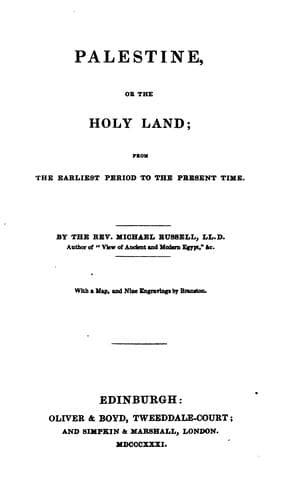
Palestine, or, the Holy Land: From the Earliest Period to the Present TimeRussell, Michael
History
Palestine, or, the Holy Land: From the Earliest Period to the Present Time
Russell, Michael
Palestine -- Description and travel; Palestine -- History
As a contrast to the description of Dr. Clarke, the reader may not be
displeased to peruse the notes of Sir Frederick Henniker on the same
subject:--"Jerusalem is called, even by the Mohammedans, the Blessed
City,--the streets of it are narrow and deserted,--the houses dirty and
ragged,--the shops few and forsaken,--and throughout the whole there is
not one symptom of either commerce, comfort, or happiness. Is this the
city that men call the Perfection of Beauty, the Joy of the whole
Earth?--The town, which appears to me not worth possession, even without
the trouble of conquest, is walled entirely round, is about a mile in
length and half a mile in width, so that its circumference may be
estimated at three miles. In three quarters of an hour I performed the
circuit. It would be difficult to conceive how it could ever have been
larger than it now is; for, independent of the ravines, the four outsides
of the city are marked by the brook of Siloam, by a burial-plate at either
end, and by the Hill of Calvary; and the Hill of Calvary is now within the
town, so that it was formerly smaller than it is at present. The best view
of it is from the Mount of Olives; it commands the exact shape, and nearly
every particular, namely, the Church of the Holy Sepulchre, the Armenian
Convent, the Mosque of Omar, St. Stephen's Gate, the round-topped houses,
and the barren vacancies of the city. The Mosque of Omar is the St.
Peter's of Turkey. The building itself has a light, pagoda appearance; the
garden in which it stands occupies a considerable part of the city, and
contrasted with the surrounding desert is beautiful; but it is forbidden
ground, and Jew or Christian entering within its precincts must, if
discovered, forfeit either his religion or his life."[76]
The observation made by Sir Frederick, in regard to the difficulty and
danger of entering the Mosque of Omar, has been verified on more than one
occasion. But the obstacles, apparently insurmountable, were overcome by
Dr. Richardson, who, in return for the successful exercise of his
professional skill, was rewarded by a clandestine visit to the shrine of
the Mussulman saint. It will appear, from the few details which we are
about to select from his volume, that the veil of mystery does not conceal
anything really worth seeing. Like Pompey in the Temple, the Christian
visiter, whose presence, in like manner, profanes the holy place, feels no
other surprise than is occasioned by the fact, that men have agreed to
excite curiosity by prohibiting an imaginary gratification.
Public-domain text, read in full here on John Shaqi.
Reviews
Reviews
No reviews yet
Be the first to share your thoughts on this work.
Elsewhere in the archive
Join the Discussion
Join the discussion
Sign in to leave a comment or review.
Sign InorCreate an account