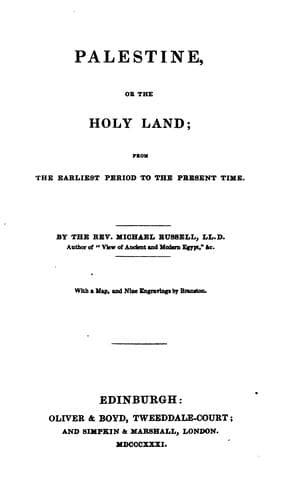
Palestine, or, the Holy Land: From the Earliest Period to the Present TimeRussell, Michael
History
Palestine, or, the Holy Land: From the Earliest Period to the Present Time
Russell, Michael
Palestine -- Description and travel; Palestine -- History
Dr. Richardson was afterward permitted to visit this splendid mosque
during the day, when he found that the dimensions of the enclosure in
which it stands is about fifteen hundred feet in length, and a thousand in
breadth. In the sacred retirement of this charming spot, the followers of
the Prophet delight to saunter, or repose, as in the elysium of their
devotions; and, arrayed in the gorgeous costume of the East, add much to
the interest, the beauty, and solemn stillness of the scene, from which
they seem loath to retire. The Sakhara itself is a regular octagon of
about sixty feet a side, and is entered by four spacious doors, each of
which is adorned with a porch projecting from the line of the building and
rising considerably on the wall. All the sides of it are paneled. The
centre stone of one panel is square, of another it is octagonal, and thus
they alternate all round; the sides of each running down the angles like a
plain pilaster, and giving an appearance as if the whole were set in a
frame. The marble is white, with a considerable tinge of blue; square
pieces of the latter colour being introduced in different places, so as to
confer upon the exterior a very pleasing effect. The upper story is faced
with small tiles painted of different colours, white, yellow, green, and
blue; some of them are also covered with sentences from the Koran. At this
height there are seven elegant windows on each side, except where the
porches interfere, and then there are only six; the general appearance of
the edifice being extremely light and beautiful, more especially from the
mixture of the soft colours above and the delicate tints of the marble in
the main body of the structure.
The interior fully corresponds to the magnificence and beauty just
described. There are twenty-four marble columns, placed parallel to the
eight sides of the building, three opposite to each side, so as still to
preserve the octagonal form. Eight of them are large plain pillars
belonging to no particular order of architecture, and all standing
opposite to the eight entering angles of the edifice, and deeply indented
on the inner side; so that they furnish an acute termination to the
octagonal lines within. Between every two of the square columns there are
two of a round figure, well proportioned, and resting on a base. They are
from eighteen to twenty feet high, with a sort of Corinthian capital. A
large square plinth of marble extends from the top of the one column to
the other, and above it there is constructed a number of arches all round,
which support the inner end of the roof or ceiling, the outer end resting
upon the walls of the building. This is composed of wood, or plaster,
highly ornamented with a species of carving, and richly gilt.
Public-domain text, read in full here on John Shaqi.
Reviews
Reviews
No reviews yet
Be the first to share your thoughts on this work.
Elsewhere in the archive
Join the Discussion
Join the discussion
Sign in to leave a comment or review.
Sign InorCreate an account