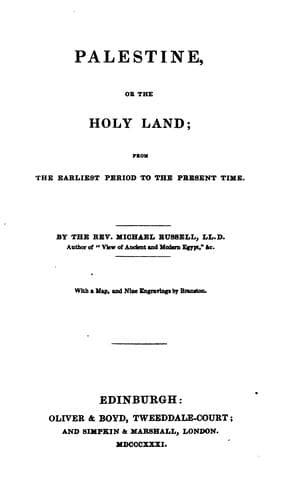
Palestine, or, the Holy Land: From the Earliest Period to the Present TimeRussell, Michael
History
Palestine, or, the Holy Land: From the Earliest Period to the Present Time
Russell, Michael
Palestine -- Description and travel; Palestine -- History
Within the same enclosure there is another house of prayer called El Aksa,
which, though a fine building, is greatly inferior to El Sakhara. Between
the two there is a beautiful fountain, which takes its name from a clump
of orange-trees overshadowing its water. The mosque is composed of seven
naves supported by pillars and columns, and at the head of the centre nave
is a fine cupola. Two others branch off at right angles to the principal
body of the edifice. Before it is a portico of seven arches in front and
one in depth, supported by square pillars. Ali Bey, who in his character
of Mussulman was permitted to examine the holy fane at leisure, describes
the great central nave of the Aksa as about 162 feet long and 32 broad. It
is supported on each side by seven arches lightly pointed, resting upon
cylindrical pillars, in the form of columns, but without any architectural
proportion, with foliaged capitals which do not belong to any order. The
fourth pillar to the right of the entrance is octangular, and enormously
thick. It is called the pillar of Sidi Omar. The walls rise 13 feet above
the tops of the arches, and contain two rows of twenty-one windows each.
The roof is of timber, without being vaulted. The cupola is supported by
four large arches resting upon four square pillars. It is spherical, with
two rows of windows, and is ornamented with arabesque paintings and
gilding of exquisite beauty. Its diameter is equal to that of the central
nave.
M. Burckhardt describes the Holy House in Jerusalem as a union of several
buildings erected at different periods of Islamism, bearing upon them
demonstrative proofs of the prevailing taste of the various ages in which
they were successively constructed. It is not precisely one mosque, but a
group of mosques. Its name in Arabic, El Haram, strictly signifies a
temple or place consecrated by the peculiar presence of the Divinity. The
profane and the infidel are forbidden to enter it. The Mussulman religion
acknowledges but two temples, those, namely, of Mecca and of Jerusalem;
both are called El Haram; both are equally prohibited by law to
Christians, Jews, and every other person who is not a believer in the
Prophet. The mosques, on the other hand, are considered merely as places
of meeting for certain acts of worship, and are not held so especially
consecrated as to demand the total exclusion of all who do not profess the
true faith. Entrance into them is not denied to the unbeliever by any
statute of the Mohammedan law; and hence it is not uncommon for Christians
at Constantinople to receive from the government a written order to visit
even the Mosque of St. Sophia. But the sultan himself could not grant
permission to an infidel either to pass into the territory of Mecca, or to
enter the Temple of Jerusalem. A firman granting such privileges would be
regarded as a most horrid sacrilege: it would not be respected by the
people; and the favoured object would inevitably become the victim of his
Public-domain text, read in full here on John Shaqi.
Reviews
Reviews
No reviews yet
Be the first to share your thoughts on this work.
Elsewhere in the archive
Join the Discussion
Join the discussion
Sign in to leave a comment or review.
Sign InorCreate an account