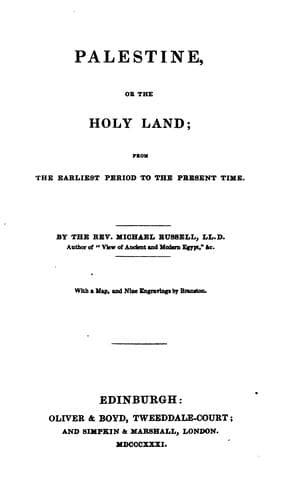
Palestine, or, the Holy Land: From the Earliest Period to the Present TimeRussell, Michael
History
Palestine, or, the Holy Land: From the Earliest Period to the Present Time
Russell, Michael
Palestine -- Description and travel; Palestine -- History
On Calvary is shown the spot where the Redeemer was nailed to the cross,
the hole into which the end of it was fixed, and the rent in the rock. All
these are covered with marble, perforated in the proper places, so that
they may be seen and touched. Near at hand a cross is erected on an
elevated part of the ground, and a wooden body stretched upon it in the
attitude of suffering. Descending from the Mount, the traveller enters the
chapel of St. Helens, the mother of Constantine, in which is the vault
where the true cross is said to have been found,--an event that continues
to be celebrated every year on the third of May by an appropriate mass.
The place is large enough to contain about thirty or forty individuals,
and on that annual solemnity it is usually crowded to the door.
The spirit in which these commemorations are sometimes performed is by no
means honourable to the Christian character. An ancient rivalry between
the members of the Greek and those of the Roman communion continues to
imbitter their disputes in regard to their respective privileges and
procedure. Maundrell informs us that in his time each fraternity had their
own altar and sanctuary, at which they had a peculiar right to celebrate
divine services and to exclude all other nations. But, says he, that which
has always been the great prize contended for by the several sects, is the
command and appropriation of the holy Sepulchre; a privilege contested
with so much unchristian fury and animosity, especially between the Greeks
and Latins that, in disputing which party should go in to celebrate their
mass, they have sometimes proceeded to blows and wounds, even at the very
door of the sepulchre, mingling their own blood with their sacrifices. The
King of Franca interposed about the end of the seventeenth century, and
obtained an order for the grand vizier to put that holy place into the
possession of the Western Church; an arrangement which was accomplished in
the year 1690, and secured to the Latins the exclusive privilege of saying
mass in it. "And though it be permitted to Christians of all nations to go
into it for their private devotions, yet none other may solemnize any
public office of religion there."[82]
The daily employment of these recluses is to trim the lamps, and to make
devotional visits and processions to the several sanctuaries in the
church. Thus they spend their time, many of them for four or six years
together; nay, so far are some transported with the pleasing contemplation
in which they here entertain themselves, that they will never come out to
their dying day; burying themselves, as it were, alive in our Lord's
grave.
Public-domain text, read in full here on John Shaqi.
Reviews
Reviews
No reviews yet
Be the first to share your thoughts on this work.
Elsewhere in the archive
Join the Discussion
Join the discussion
Sign in to leave a comment or review.
Sign InorCreate an account