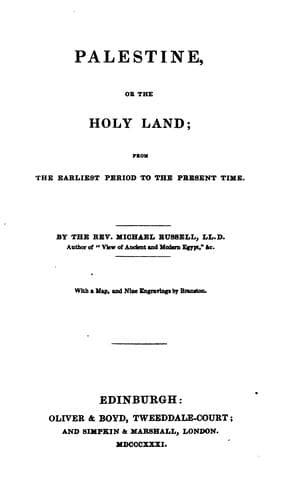
Palestine, or, the Holy Land: From the Earliest Period to the Present TimeRussell, Michael
History
Palestine, or, the Holy Land: From the Earliest Period to the Present Time
Russell, Michael
Palestine -- Description and travel; Palestine -- History
"From this place they went up to Calvary, leaving their shoes at the
bottom of the stairs. Here are two altars to be visited; one where our
Lord is supposed to have been nailed to the cross, another where his cross
was erected. At the former of these they laid down the great crucifix upon
the floor, and acted a kind of resemblance of Christ's being nailed to the
cross; and after the hymn another friar preached a sermon in Spanish upon
the crucifixion. From hence they removed to the adjoining altar, where the
cross is supposed to have been erected, bearing the image of our Lord's
body. At this altar is a hole in the natural rock, said to be the very
same individual one in which the foot of our Lord's cross stood. Here they
set up their cross with the bloody crucified image upon it; and leaving it
in that posture, they first sang their hymn, and then the father guardian,
sitting in a chair before it, preached a passion sermon in Italian.
"At about one yard and a half distant from the hole in which the foot of
the cross was fixed is seen that memorable cleft in the rock, said to have
been made by the earthquake which happened at the suffering of the God of
nature; when, as St. Matthew witnesseth, the rocks rent and the very
graves were opened. This cleft, or what now appears of it, is about a span
wide at its upper part, and two deep; after which it closes. But it opens
again below, as you may see in another chapel contiguous to the side of
Calvary, and runs down to an unknown depth in the earth. That this rent
was made by the earthquake that happened at our Lord's passion there is
only tradition to prove; but that it is a natural and genuine breach, and
not counterfeited by any art, the sense and reason of every one that sees
it may convince him; for the sides of it fit like two tallies to each
other, and yet it runs in such intricate windings as could not well be
counterfeited by art, nor arrived at by any instruments.
Public-domain text, read in full here on John Shaqi.
Reviews
Reviews
No reviews yet
Be the first to share your thoughts on this work.
Elsewhere in the archive
Join the Discussion
Join the discussion
Sign in to leave a comment or review.
Sign InorCreate an account