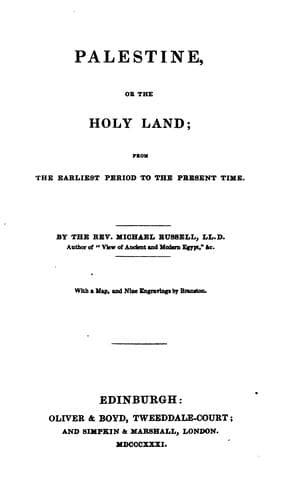
Palestine, or, the Holy Land: From the Earliest Period to the Present TimeRussell, Michael
History
Palestine, or, the Holy Land: From the Earliest Period to the Present Time
Russell, Michael
Palestine -- Description and travel; Palestine -- History
It was of the older building that the Vicomte made the following
remarks:--"The church of the Holy Sepulchre, composed of several churches
erected upon an unequal surface, illumined by a multitude of lamps, is
singularly mysterious; a sombre light pervades it, favourable to piety and
profound devotion. Christian priests of various sects inhabit different
parts of the edifice. From the arches above, where they nestle like
pigeons, from the chapels below and subterraneous vaults, their songs are
heard at all hours both of the day and night. The organ of the Latin
monks, the cymbals of the Abyssinian priest, the voice of the Greek
caloyer, the prayer of the solitary Armenian, the plaintive accents of the
Coptic friar, alternately, or all at once, assail your ear. You know not
whence these accents of praise proceed; you inhale the perfume of incense
without perceiving the hand that burns it: you merely observe the pontiff,
who is going to celebrate the most awful of mysteries on the very spot
where they were accomplished, pass quickly by, glide behind the columns,
and vanish in the gloom of the temple.
"Christian readers will perhaps inquire what were my feelings upon
entering this sacred place. I really cannot tell. So many reflections
rushed at once upon my mind, that I was unable to dwell upon any
particular idea. I continued nearly half an hour upon my knees in the
little chamber of the Holy Sepulchre, with my eyes riveted upon the stone,
from which I had not the power to turn them. One of the two monks who
accompanied me remained prostrate on the marble by my side, while the
other, with the Testament in his hand, read to me by the light of the
lamps the passages relating to the sacred tomb. All I can say is that when
I beheld this triumphant Sepulchre, I felt nothing but my own weakness;
and that when my guide exclaimed with St. Paul, O death, where is thy
sting? O grave, where is thy victory? I listened, as if death were about
to reply that he was conquered and enchained in this monument. Where shall
we look in antiquity for anything so impressive, so wonderful, as the last
scenes described by the Evangelists? These are not the absurd adventures
of a deity foreign to human nature: it is a most pathetic history,--a
history which not only extorts tears by its beauty, but whose
consequences, applied to the universe, have changed the face of the earth.
I had just beheld the monuments of Greece, and my mind was still
profoundly impressed with their grandeur; but how far inferior were the
sentiments which they excited to those I felt at the sight of the places
commemorated in the gospel!"[93]
Public-domain text, read in full here on John Shaqi.
Reviews
Reviews
No reviews yet
Be the first to share your thoughts on this work.
Elsewhere in the archive
Join the Discussion
Join the discussion
Sign in to leave a comment or review.
Sign InorCreate an account