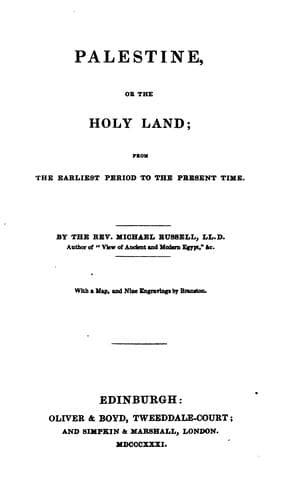
Palestine, or, the Holy Land: From the Earliest Period to the Present TimeRussell, Michael
History
Palestine, or, the Holy Land: From the Earliest Period to the Present Time
Russell, Michael
Palestine -- Description and travel; Palestine -- History
There are various other grottoes on the acclivity of the hill, meant to
keep alive the remembrance of certain occurrences which are either
mentioned in the gospel, or have been transmitted to the present age by
oral tradition. Among these is one which is supposed to be the scene of
the agony and the bloody sweat; a second, that marks the place where St.
Peter and the two sons of Zebedee fell asleep when their Master retired to
pray; and a third, indicating the spot whereon Judas betrayed the Son of
Man with a kiss. Here also is pointed out the rock from which our Saviour
predicted the sack of Jerusalem and the destruction of the Temple,--that
dreadful visitation, of which the traces are still most visible both
within and around the walls. The curious pilgrim is further edified by the
sight of a cavern where the apostles were taught the Lord's Prayer; and of
another where the same individuals at a later period met together to
compose their Creed. On the principal top of the Mount of Olives,--for the
elevated ground presents three separate summits,--are a mosque and the
remains of a church. The former is distinguished by a lofty minaret which
commands an extensive prospect; but the latter is esteemed more
remarkable, as containing the piece of rock imprinted with the mark of our
Saviour's foot while in the act of ascension.
But the view of the venerable metropolis itself, which stretches out its
lance and sacred enclosures under the eye of the traveller, is still more
interesting than the recapitulation of ambiguous relics. It occupies an
irregular square of about two miles and a half in circumference. Eusebius
gave a measurement of twenty-seven stadia, amounting to nearly a mile more
than its present dimensions; a difference which can easily be explained,
by adverting to the alterations made on the line of fortifications by the
Saracens and Turks, especially on the north-west and western extremities
of the town. Its shortest apparent side is that which faces the east, and
in this is the supposed gate of the ancient Temple, shut up by the
Mussulmans from a superstitious motive, and the small projecting stone on
which their prophet is to sit when he shall judge the world assembled in
the vale below. The southern side is exceedingly irregular, taking quite a
zigzag direction; the south-western entrance being terminated by a mosque
built over the supposed sepulchre of David, on the elevation of Mount
Zion. The form and exact direction of the western and northern walls are
not distinctly seen from the position now assumed; but every part of them
appears to be a modern work, and executed at the same time. They are
flanked at certain distances by square towers, and have battlements all
along their summits, with loopholes for arrows or musketry close to the
top. Their height is about fifty feet, but they are not surrounded by a
ditch. The northern wall runs over ground which declines slightly outward;
Public-domain text, read in full here on John Shaqi.
Reviews
Reviews
No reviews yet
Be the first to share your thoughts on this work.
Elsewhere in the archive
Join the Discussion
Join the discussion
Sign in to leave a comment or review.
Sign InorCreate an account