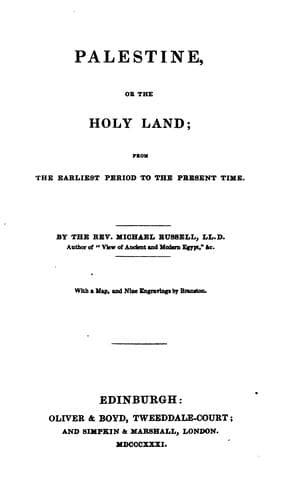
Palestine, or, the Holy Land: From the Earliest Period to the Present TimeRussell, Michael
History
Palestine, or, the Holy Land: From the Earliest Period to the Present Time
Russell, Michael
Palestine -- Description and travel; Palestine -- History
As there was another town of the same name in the tribe of Zebulon, the
Bethlehem that we now approach was usually distinguished by the addition
of Ephrata, or by a reference to the district in which it was situated.
The convent which marks the place of the Redeemer's birth was built by
Helena, after removing the idolatrous structure said to have been erected
by Adrian from a feeling of contempt or jealousy towards the Christians.
At present it is divided among the monks of the Greek, Roman, and Armenian
sects, who have assigned to them separate portions, as well for lodging as
for places of worship; though, on certain days, they may all celebrate the
rites of their common faith on altars which none of them have been
hitherto allowed to appropriate. There are two churches, an upper and a
lower, under the same roof. The former contains nothing remarkable, if we
except a star inlaid in the floor, immediately under the spot in the
heavens where the supernatural sign became visible to the wise men, and,
like it, directly above the place of the Nativity in the church below.
This last is an excavation in the rock, elegantly fitted up and floored
with marble, and to which there is a descent by a flight of steps through
a long narrow passage. Here are shown a great number of tombs, and among
them one in which were said to be buried all the babes of Bethlehem
murdered by the barbarous Herod. From hence the pilgrim is conducted into
a handsome chapel, of which the floors and walls are composed of beautiful
marble, having on each side five oratories, or recesses for prayer,
corresponding to the ten stalls supposed to have been in the stable
wherein our blessed Saviour was born. This sacred crypt is irregular in
shape, because it occupies the site of the stable and the manger. It is
thirty-seven feet six inches long, eleven feet three inches broad, and
nine feet in height. As it receives no light from without, it is illumined
by thirty-two lamps, sent by different princes of Christendom; the other
embellishments are ascribed to the munificent Helena. At the farther
extremity of this small church there is an altar placed in an arcade, and
hollowed out below in the form of an arch, to embrace the sacred spot
where Emmanuel, having laid aside his glory, first appeared in the garb of
human nature. A circle in the floor composed of marble and jasper,
surrounded with silver, and having rays like those with which the sun is
represented, marks the precise situation wherein that stupendous event was
realized. An inscription, denoting that "here Jesus Christ was born of the
Virgin Mary," meets the eye of the faithful worshipper.
Hic de Virgine Maria Jesus Christus natus est.
Public-domain text, read in full here on John Shaqi.
Reviews
Reviews
No reviews yet
Be the first to share your thoughts on this work.
Elsewhere in the archive
Join the Discussion
Join the discussion
Sign in to leave a comment or review.
Sign InorCreate an account