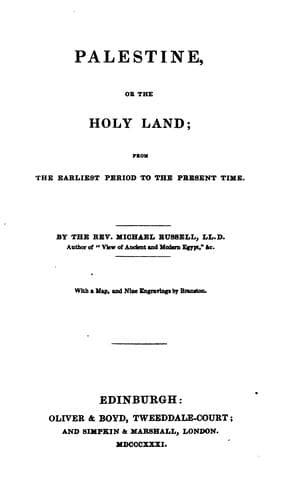
Palestine, or, the Holy Land: From the Earliest Period to the Present TimeRussell, Michael
History
Palestine, or, the Holy Land: From the Earliest Period to the Present Time
Russell, Michael
Palestine -- Description and travel; Palestine -- History
On leaving the Church of the Nativity the traveller pursues his course
eastward, through a vale where Abraham is said to have fed his flocks.
This pastoral tract, however, is soon succeeded by a range of hilly
ground, so extremely barren that not even a root of moss is to be seen
upon it. Descending the farther side of this meager platform two lofty
towers are perceived, rising from a deep valley, marking the site of the
Convent of Santa Saba. Nothing can be more dreary than the situation of
this religious house. It is erected in a ravine, sunk to the depth of
several hundred feet, where the brook Kedron has formed a channel, which
is dry the greater part of the year. The church is on a little eminence at
the bottom of the dell; Whence the buildings of the monastery rise by
perpendicular flights of steps and passages hewn out of the rock, and thus
ascend to the ridge of the hill, where they terminate is the two square
towers already mentioned. From hence you descry the sterile summits of the
mountains both towards the east and west; the course of the stream from
Jerusalem; and the numerous grottoes formerly occupied by Christian
anchorites.
In advancing, the aspect of the country still continues the same, white
and dusty, without tree, herbage, or even moss. At length the road seeks a
lower level, and approaches the rocky border which bounds the Valley of
the Jordan; when, after a toilsome journey of ten or twelve hours, the
traveller sees stretching out before his eyes the Dead Sea and the line of
the river. But the landscape, however grand, admits of no comparison to
the scenery of Europe. No fields waving with corn,--no plains covered with
rich pasture present themselves from the mountains of Lower Palestine.
Figure to yourself two long chains of mountains, running in a parallel
direction from north to south, without breaks and without undulations. The
eastern or Arabian chain is the highest; and, when seen at the distance of
eight or ten leagues, you would take it to be a prodigious perpendicular
wall, resembling Mount Jura in its form and azure colour. Not one summit,
not the smallest peak can be distinguished; you merely perceive slight
inflections here and there, "as if the hand of the painter who drew this
horizontal line along the sky had trembled in some places."
Public-domain text, read in full here on John Shaqi.
Reviews
Reviews
No reviews yet
Be the first to share your thoughts on this work.
Elsewhere in the archive
Join the Discussion
Join the discussion
Sign in to leave a comment or review.
Sign InorCreate an account