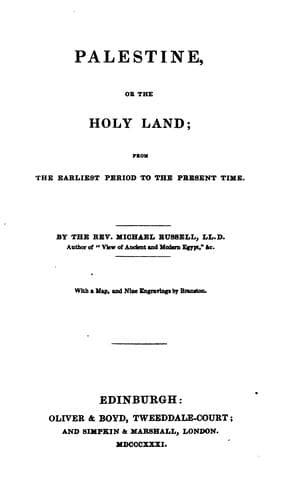
Palestine, or, the Holy Land: From the Earliest Period to the Present TimeRussell, Michael
History
Palestine, or, the Holy Land: From the Earliest Period to the Present Time
Russell, Michael
Palestine -- Description and travel; Palestine -- History
From Tiberias to Nazareth the traveller has to encounter an almost
uninterrupted ascent. The village of Caber Sabet first attracts his
attention by its architectural remains, indicating the existence of an
ancient building, which must have had marble columns and a magnificent
portico. He soon afterwards reaches Soak el Khan,--a place chiefly
celebrated for a weekly market, where every description of commodity in
use among the people is collected for sale. It also presents the ruins of
a Saracenic fort of a square shape, with circular towers at the angles and
in the centre of each wall.
In pursuing this route we have Mount Tor, or Tabor, on the left-hand,
rising in solitary majesty from the Plain of Esdraëlon. Its appearance has
been described by some authors as that of a half-sphere, while to others
it suggests the idea of a cone with its point struck off. According to Mr.
Maundrell, the height is such as to require the labour of an hour to reach
the summit; where is seen a level area of an oval figure, extending about
two furlongs in length and one in breadth. It is enclosed with trees on
all sides except the south, and is most fertile and delicious. Having been
anciently surrounded with walls and trenches, there are remains of
considerable fortifications at the present day. Burckhardt says, a thick
wall, constructed of large stones, may be traced quite round the summit,
close to the edge of the precipice; on several parts of which are relics
of bastions. The area too is overspread with the ruins of private
dwellings, built of stone with great solidity.
Pococke assures us that it is one of the finest hills he ever beheld,
being a rich soil that produces excellent herbage, and most beautifully
adorned with groves and clumps of trees. The height he calculates to be
about two miles, making allowance for the winding ascent; but he adds,
that others have imagined the same path to be not less than four miles.
Hasselquist conjectures that it is a league to the top, the whole of which
may be accomplished without dismounting,--a statement amply confirmed by
the experience of Van Egmont and Heyman. These travellers relate that
"this mountain, though somewhat rugged and difficult, we ascended on
horseback, making several circuits round it, which took up about
three-quarters of an hour. It is one of the highest in the whole country,
being thirty stadia, or about four English miles. And it is the most
beautiful we ever saw with regard to verdure, being everywhere decorated
with small oak-trees, and the ground universally enamelled with a variety
of plants and flowers. There are great number of red partridges, and some
wild boars; and we were so fortunate as to see the Arabs hunting them. We
left, but not without reluctance, this delightful place, and found at the
bottom of it a mean village, called Deboura, or Tabour,--a name said to be
derived from the celebrated Deborah mentioned in the book of Judges."
Public-domain text, read in full here on John Shaqi.
Reviews
Reviews
No reviews yet
Be the first to share your thoughts on this work.
Elsewhere in the archive
Join the Discussion
Join the discussion
Sign in to leave a comment or review.
Sign InorCreate an account