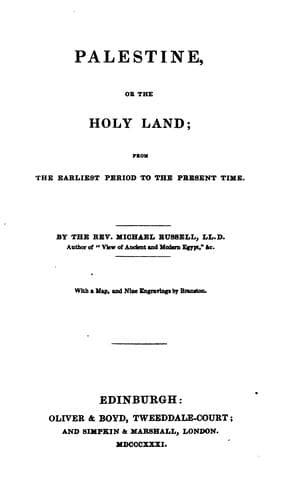
Palestine, or, the Holy Land: From the Earliest Period to the Present TimeRussell, Michael
History
Palestine, or, the Holy Land: From the Earliest Period to the Present Time
Russell, Michael
Palestine -- Description and travel; Palestine -- History
The plain around, the most fertile part of the Land of Canaan, being one
vast meadow covered with the richest pasture, is the inheritance where the
tribe of Issachar "rejoiced in their tents." Here it was that Barak,
descending with his ten thousand men from Tabor, discomfited Sisera and
all his chariots. In the same neighbourhood Josiah, king of Judah, fought
in disguise against Necho, king of Egypt, and fell by the arrows of his
antagonist, deeply lamented. The great mourning in Jerusalem, foretold
by Zechariah, is said to be as the lamentations in the Plain of Esdraëlon,
as the mourning of Hadadrimmon in the Valley of Megiddon. Vespasian
reviewed his army in the same great plain. It has been a chosen place for
encampments in every contest carried on in this country, from the days of
Nebuchadnezzar, king of the Assyrians, down to the disastrous invasion of
Napoleon Bonaparte. Jews, Gentiles, Saracens, Egyptians, Persians, Druses,
Turks, Arabs, Christian Crusaders, and Antichristian Frenchmen,--warriors
out of every nation under heaven,--have pitched their tents upon the Plain
of Esdraëlon, and have beheld their various banners wet with the dews of
Tabor and of Hermon. And shall we not add that here too is to be fought
the great battle of Armageddon, so well known to all interpreters of
prophecy, which is expected to change the aspect of the eastern world?
When the French invaded Syria in 1799, General Kleber was attacked near a
village called Fouleh, in the Great Plain, by an army of 25,000 Turks. At
the head of twelve or fifteen hundred men, whom he formed into a square,
he continued fighting from sunrise till midday, when he had expended all
his ammunition. Bonaparte, at length, informed of his perilous situation,
advanced to his support with six hundred soldiers; at the sight of whom
the enemy, after having lost several thousands in killed and wounded,
commenced a hurried retreat, in the course of which many of them were
drowned in the River Daboury, at that time, like another Kishon,
overflowing its banks. In a word, the champaign country which stretches
north-west from Tabor has been the theatre of real or of mimic warfare in
all ages. "We had the pleasure," says Doubdan, "to view from the top of
that mountain Arabs encamped by thousands; tents and pavilions of all
colours, green, red, and yellow; with so great a number of horses and
camels, that it seemed like a vast army, or a city besieged."[151]
Public-domain text, read in full here on John Shaqi.
Reviews
Reviews
No reviews yet
Be the first to share your thoughts on this work.
Elsewhere in the archive
Join the Discussion
Join the discussion
Sign in to leave a comment or review.
Sign InorCreate an account