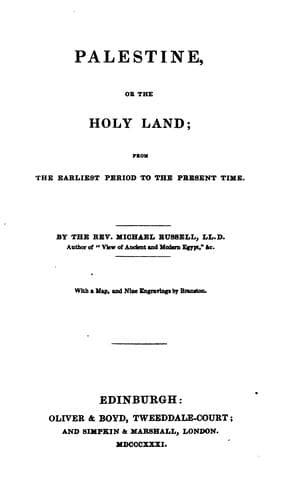
Palestine, or, the Holy Land: From the Earliest Period to the Present TimeRussell, Michael
History
Palestine, or, the Holy Land: From the Earliest Period to the Present Time
Russell, Michael
Palestine -- Description and travel; Palestine -- History
The Mount of Precipitation, as it is now called, is, according to Mr.
Buckingham, about two miles distant from Nazareth; is almost inaccessible,
from the steep and rocky nature of the road; and is decidedly not upon the
hill where the town could ever have been built. Dr. Clarke, on the other
hand, maintains that the words of the evangelist are most explicit, and
prove the situation of the ancient city to have been precisely that which
is now occupied by the modern town. In a recess there is an altar hewn out
of the rock, said to be the very spot where Christ dined with his
disciples. Close by are two large cisterns for preserving rain-water, and
several portions of buildings, all described as the remains of a religious
establishment founded by the pious and indefatigable Helena. Immediately
over this scene, and on the edge of a precipice about thirty feet in
height, are two flat stones set up on their edges. In the centre, and
scattered over different parts of one of them, are several round marks
like the deep imprint of fingers on wax; and it is insisted that these are
the impression of our Saviour's hand when he clung to the stone, and
thereby escaped being thrown headlong down.[156]
One celebrated relic still remains to be noticed, which, although it is
not alluded to in the New Testament, is regularly authenticated by the
pope; who, besides, grants a plenary indulgence to every pilgrim visiting
the place where it is exhibited. This is nothing more than a large stone,
on which it is affirmed that Christ did eat with his disciples both before
and after his resurrection from the dead. A chapel has been built over it,
on the walls of which are several copies of a printed certificate, stating
the grounds of its claim to veneration. Dr. Clarke transcribed this
curious document, which we give in a note below, accompanied with a
translation for the use of such readers as have not formed an acquaintance
with the Latin tongue.[157]
There is not an object in all Nazareth so much the resort of
pilgrims,--Greeks, Catholics, Arabs, and even Turks,--as this stone: the
former classes on account of the seven years' indulgence granted to those
who visit it; the two latter, because they believe some virtue must reside
in a slab before which all comers are so eager to prostrate themselves.
In a valley near the town is a fountain which bears the name of the
Virgin, and where the women are seen passing to and fro with pitchers on
their heads, as in the days of old. It is justly remarked, that, if there
be a spot throughout the Holy Land which was more particularly honoured by
the presence of Mary, we may consider this to be the place; because the
situation of a copious spring is not liable to change, and because the
custom of repairing thither to draw water has been continued among the
female inhabitants of Nazareth from the earliest period of its history.
Public-domain text, read in full here on John Shaqi.
Reviews
Reviews
No reviews yet
Be the first to share your thoughts on this work.
Elsewhere in the archive
Join the Discussion
Join the discussion
Sign in to leave a comment or review.
Sign InorCreate an account