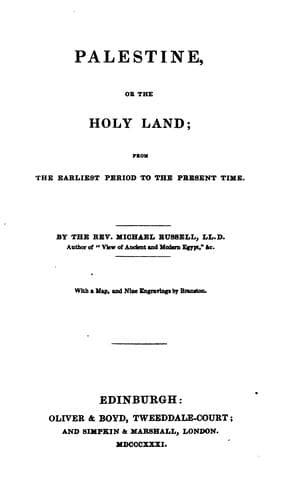
Palestine, or, the Holy Land: From the Earliest Period to the Present TimeRussell, Michael
History
Palestine, or, the Holy Land: From the Earliest Period to the Present Time
Russell, Michael
Palestine -- Description and travel; Palestine -- History
To check the mutinous disposition, or to weaken the influence of the
vanquished tribes, an edict was promulgated by their Roman masters,
forbidding circumcision, the reading of the Law, and the observance of the
weekly Sabbath. Still further to defeat their favourite schemes, and to
blast all hopes of a restoration to civil power in Jerusalem under their
Messiah, it was resolved by the government at Rome to repair to a certain
extent the city of the Jews, and to establish in it a regular colony of
Greeks and Latins. At this crisis appeared the notorious Barcochab, whose
name, denoting the "son of a star," made him be instantly hailed by a
large majority of the nation as that predicted light which was to arise
out of Jacob in the latter days. Recommended by Akiba, one of the most
popular of the Rabbim, to the confidence of Israel, this impostor soon saw
himself at the head of a powerful army; amounting, say the Jewish
annalists, to more than two hundred thousand men. In the absence of the
legions now called to other parts of the East, he found little difficulty
in taking possession of Jerusalem; and before a competent force, under the
renowned Julius Severus, could arrive in Palestine, the false Messias had
seized fifty of the strongest castles, and a great number of open towns.
The details of the sanguinary campaigns which followed are given by the
vanquished Jews with more minuteness than probability. Severus, who had
learned all the arts of desultory warfare when employed against the
barbarians of Britain, used a similar policy on the banks of the Jordan;
choosing to cut off the supplies of the enemy, and attack their posts with
overwhelming numbers, rather than encounter their furious fanaticism in a
general engagement. Bither, a strong city, and defended by Barcochab in
person, was the last to yield to the Romans. At length it was taken by
storm, at the expense of much human life on either side; but as the leader
of the rebellion was among the slain, the victors did not consider their
success too dearly bought, as with the star whose light was extinguished
in the carnage of Bither the hope of Israel fell to the earth. Dio Cassius
relates, that during this war no fewer than 580,000 fell by the sword,
besides those who perished by famine and disease. The whole of Judea was
converted into a desert,--wolves and hyenas howled in the streets of the
desolate cities,--and all the villages were consumed with fire.
Public-domain text, read in full here on John Shaqi.
Reviews
Reviews
No reviews yet
Be the first to share your thoughts on this work.
Elsewhere in the archive
Join the Discussion
Join the discussion
Sign in to leave a comment or review.
Sign InorCreate an account