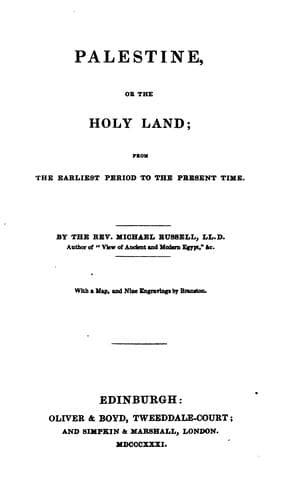
Palestine, or, the Holy Land: From the Earliest Period to the Present TimeRussell, Michael
History
Palestine, or, the Holy Land: From the Earliest Period to the Present Time
Russell, Michael
Palestine -- Description and travel; Palestine -- History
Several generations passed away, during which the affairs of the Holy Land
created no interest in Europe, and when Christians and Jews, who could
hardly obtain the most limited toleration from their Mohammedan masters,
sought an asylum among the states of Europe. In the Travels of Benjamin of
Tudela are to be found some incidental notices which leave no doubt as to
the fact that his countrymen, unable to bear the persecution directed
against them, had gradually abandoned the birthplace of their fathers.
Jerusalem, in the twelfth century, did not contain more than two hundred
descendants of Abraham, poor, depressed, and calumniated; while at
Tiberias, the seat of learning and of their sovereign patriarch, the
number did not exceed fifty,--the victims of suspicion and jealousy, not
less on the part of the Christians than of the Moslem, who had already
begun to contend with each other for the sepulchre of Christ.
It has often been observed, that pilgrimage to the holy places of
Palestine was from a very early period regarded as at once a wholesome
discipline and an acceptable reverence on the part of Christian
worshippers. The Arabian califs were, on various accounts, inclined to
favour the resort of Europeans to these shrines of their faith. They saw
in it a fruitful source of revenue; while, as the progeny of Abraham,
they were not disposed to take offence at the veneration lavished upon
the prophetic son of David, whose tomb the fortune of war had placed in
their hands. But the Seljukian Turks, those irreclaimable barbarians, who
had no sympathy with the believers in Christ, laid on them such burdens
and vexatious restraints as were altogether intolerable. The cries of the
unhappy pilgrims had long resounded throughout all Christendom; and the
indignation which was universally felt against the bigoted Mussulmans was
inflamed in no slight degree by the eloquence of Peter the Hermit, who
had witnessed in foreign lands the afflictions of his brethren. Yielding
to the impulse of the age, Pope Urban the Second convoked a general
council at Clermont, in Auvergne, to whom he addressed an oration well
fitted to confirm the enthusiasm which he found already kindled. He
encouraged them to attack the enemies of God, and in that holy warfare to
earn the reward of eternal life promised to all the faithful servants of
the Redeemer; suggesting, that as a mark of their profession as well as
of their Saviour's love, they should wear red crosses on their garments
when fighting the battles of Christianity.
Public-domain text, read in full here on John Shaqi.
Reviews
Reviews
No reviews yet
Be the first to share your thoughts on this work.
Elsewhere in the archive
Join the Discussion
Join the discussion
Sign in to leave a comment or review.
Sign InorCreate an account