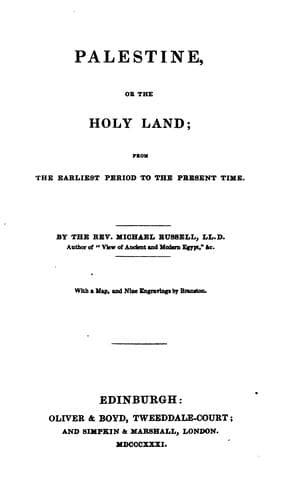
Palestine, or, the Holy Land: From the Earliest Period to the Present TimeRussell, Michael
History
Palestine, or, the Holy Land: From the Earliest Period to the Present Time
Russell, Michael
Palestine -- Description and travel; Palestine -- History
Saladin did not long survive the departure of his distinguished rival. He
died in the year 1193; leaving directions, that on the day of his funeral
a shroud should be borne on the point of a spear, and a herald proclaim in
a loud voice, "Saladin, the conqueror of Asia, out of all the fruits of
his victories, carries with him only this piece of linen." The soldiers of
this distinguished sultan rallied round his brother Saphadin, whom they
raised to the throne. Nor did the new monarch disappoint the expectations
that were entertained of his wisdom and valour; for by the exertions of
military skill, as well as by a sagacious policy, he strengthened the
government which was committed to his hands, and was found, at the
expiration of the truce, ready to meet the armies of the combined powers
of Christendom.
The fourth Crusade was called into existence by the active zeal of Pope
Celestine the Third, and of Henry the Sixth, the German emperor, who was
joined by many of the subordinate princes of Northern Europe. The term of
peace fixed by Richard and Saladin had indeed expired; but both Christians
and Moslem, exhausted by war and famine, were disposed to lengthen the
period of repose, and at all events to abstain from a renewal of their
sanguinary conflicts. Nevertheless, when the new champions of the Cross
arrived at Acre, all remonstrances against fresh aggression were
disregarded. Saphadin, who was informed of their hostile intentions,
anticipated them in the field, and before they could advance to Jaffa, he
had battered down the fortifications, and put thousands of the inhabitants
to the sword. A general action, it is true, took place soon afterward, in
which the strength and discipline of the Germans secured the victory; but,
when advancing to Jerusalem, the conquerors allowed themselves to be
turned aside in order to reduce the insignificant fortress of Thoron,
where they met with a repulse so serious as to defeat the main object of
the campaign. Factious contentions now disturbed the councils of the
Latins; vice and insubordination raged in the camp; and, to crown their
miseries, the Crusaders were informed that the Sultans of Egypt and Syria
were concentrating their troops with the view of attacking them. Alarmed
at this intelligence, the German princes deserted their posts in the
night, and fled to Tyre; the road to which was soon filled with soldiers
and baggage in indiscriminate confusion; the feeble relinquishing their
property, and the cowardly casting away their arms.
Public-domain text, read in full here on John Shaqi.
Reviews
Reviews
No reviews yet
Be the first to share your thoughts on this work.
Elsewhere in the archive
Join the Discussion
Join the discussion
Sign in to leave a comment or review.
Sign InorCreate an account