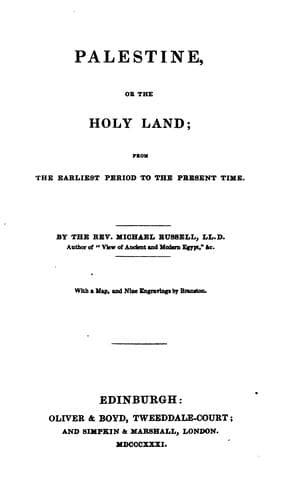
Palestine, or, the Holy Land: From the Earliest Period to the Present TimeRussell, Michael
History
Palestine, or, the Holy Land: From the Earliest Period to the Present Time
Russell, Michael
Palestine -- Description and travel; Palestine -- History
The hopes inspired by this union raised the pretensions of the Christian
community so high, that they refused to prolong the truce which still
subsisted between them and the sultan. The latter, therefore, marched an
army to the neighbourhood of Tripoli, and threatened hostilities. The
young king took the field at the head of a respectable force and
displayed his valour in many a fierce encounter; and though he did not
succeed in concerning his foes, he saved his states from the utter
annihilation with which they were threatened. He foresaw, however, the
approaching ruin of the sacred cause; for he could not fail to observe
that, while the Saracens were constantly acquiring new advantages, the
Latin barons were embracing every opportunity of returning home. He
accordingly wrote to the pope, that the kingdom of Jerusalem consisted
only of two or three towns, and that its fate must already have been
determined but for the civil wars which had raged among the sons of
Saladin.
His holiness was not deaf to a remonstrance so just and important. In
a circular letter to the sovereigns of Europe, he reminded them that
the time was now come when a successful effort might be made to secure
possession of Palestine, and that, while those who should fight
faithfully for God would obtain a crown of glory, such as refused to
serve him would be punished everlastingly. He employed, among other
arguments, a consideration which has since been often urged by Protestant
writers against his own church; stating, that "the Mohammedan heresy, the
beast foretold by the Spirit, will not live for ever--its age is 666." He
concluded with the assurance, that Jesus Christ would condemn them for
gross ingratitude and infidelity, if they neglected to march to his
succour at a time when he was in danger of being driven from a kingdom he
had acquired by his own blood.
The preacher of the next Crusade was Robert de Courçon, a man inferior in
talents and rank to St. Bernard, but whose fanaticism was as fervent as
that of the Hermit and Fulk. He invited all to assume the Cross, and
enrolled in the sacred militia women, children, the old, the blind, the
lame, and even the distempered. The multitude of Crusaders, as might be
expected, was very great, and the voluntary offerings of money were
immense. A council was held in the church of the Lateran, in which the
Emperor of Constantinople, the Kings of France, England, Hungary,
Jerusalem, Arragon, and other countries, were represented. War against the
Saracens was unanimously declared to be the most sacred duty of the
Christian world. The usual privileges, dispensations, and indulgences were
granted to the pilgrims; and the pope, besides other expenses, contributed
thirty thousand pounds.
Public-domain text, read in full here on John Shaqi.
Reviews
Reviews
No reviews yet
Be the first to share your thoughts on this work.
Elsewhere in the archive
Join the Discussion
Join the discussion
Sign in to leave a comment or review.
Sign InorCreate an account